Golden Triangle Tour: The Ultimate 7-Day Guide to Delhi, Jaipur & Agra
Golden Triangle Tour: The Ultimate 7-Day Guide to Delhi, Jaipur & Agra
India’s most iconic circuit — history, palaces, and the Taj Mahal
You Think History Started with Rome? Hold That Thought.
While Europe was still figuring out the basics, India was already building sprawling cities. While the Greeks were sketching their first columns, India was trading spices across three continents.
And right at the center of this massive history is Delhi. It’s a city that’s been rebuilt seven times over, and it doesn’t live in the past—it just keeps going. Delhi is the perfect starting point for the Golden Triangle, a travel route that connects three of India’s most famous cities: Delhi, Agra, and Jaipur. In one trip, you’ll see centuries of royal history and five UNESCO World Heritage Sites.
What Is the Golden Triangle Tour? India’s Most Iconic Road Trip Explained
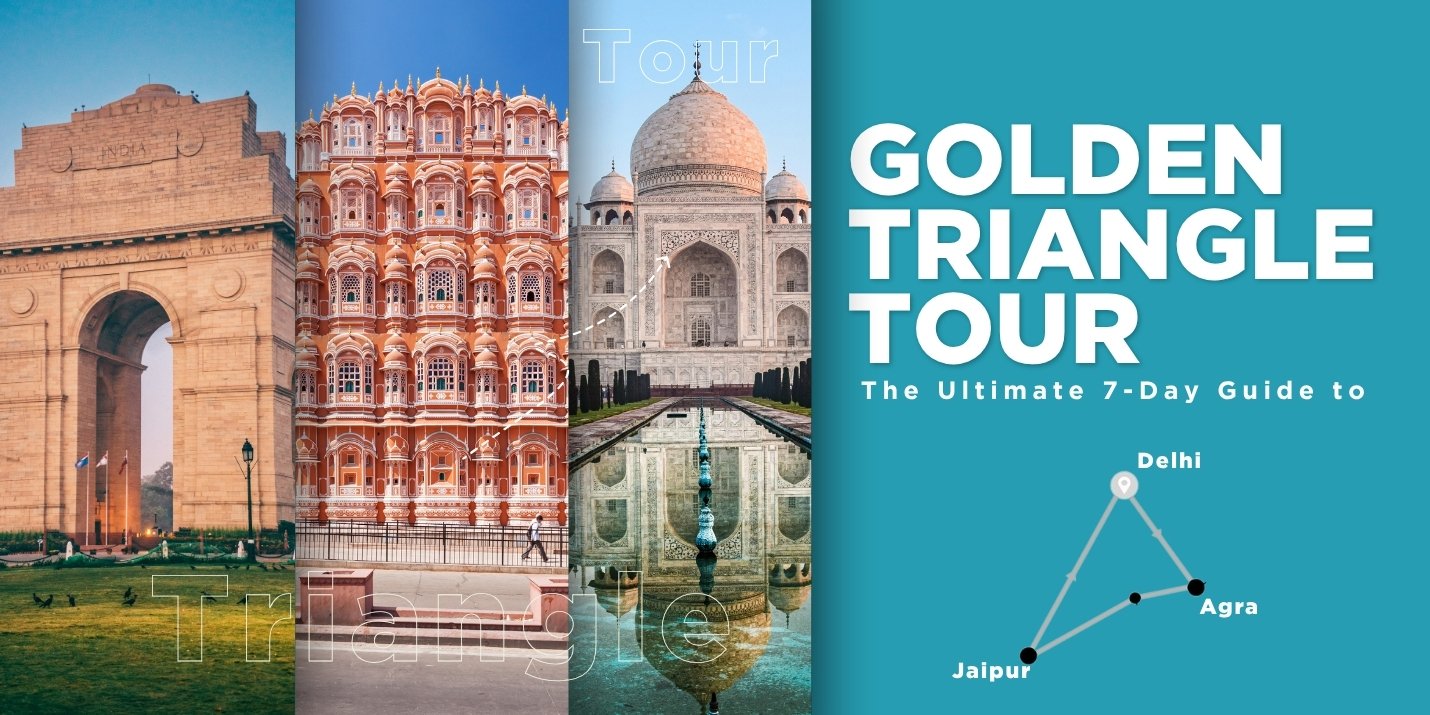
The Golden Triangle India is a travel circuit connecting three of north India’s most historically and culturally significant cities:
- New Delhi: India’s capital. Mughal grandeur meets modern metropolis.
- Agra: Home of the Taj Mahal and Agra Fort. Mughal history was at its absolute peak.
- Jaipur: The Pink City of Rajasthan. Rajput palaces, desert forts, and the finest bazaars in India.
The Golden Triangle Map
On a map, the three cities form a near-perfect triangle, hence the name. The distances are highly manageable: Delhi to Agra is roughly 130 miles (210 km), Agra to Jaipur is around 150 miles (240 km), and Jaipur back to Delhi closes the loop at about 170 miles (275 km). You can cover the entire circuit by road, train, or a combination of both.
This is why golden triangle tours from Delhi are India’s single most popular travel circuit. In one loop, you access five UNESCO World Heritage Sites, centuries of layered history, street food that ruins all other food permanently, and shopping so good you’ll need to renegotiate your luggage allowance.
Most golden triangle India packages begin and end at Indira Gandhi International Airport (DEL) in New Delhi, which has direct or one-stop flights from major US cities, including New York (JFK), Chicago (ORD), San Francisco (SFO), and Los Angeles (LAX). Flight times range from 14 to 18 hours depending on routing.
7 days is the recommended length for most travelers. Long enough to absorb each city. Short enough to keep the pace energizing rather than exhausting.
How to Get Your Visa: Step-by-Step for US Citizens & NRIs
Before anything else let’s sort the paperwork. This section is for US passport holders. NRI/OCI card holders, scroll to the note below.
Option 1: Indian e-Visa (Recommended for Most US Travelers)
The Indian e-Visa is the fastest, most convenient option and handles the vast majority of tourist entries from the US without setting foot in a consulate.
Official Application Portal: 🔗 https://indianvisaonline.gov.in/evisa/tvoa.html (This is the only government-authorized site. Avoid third-party sites charging inflated fees for the same service.)
Types available for tourism:
| Visa Type | Validity | Entries | Fee (USD) |
| e-Tourist Visa (30 days) | 30 days from arrival | Double entry | $25 |
| e-Tourist Visa (1 year) | 1 year from issue | Multiple entry | $80 |
| e-Tourist Visa (5 years) | 5 years from issue | Multiple entry | $80 |
Processing time: 3 to 5 business days in most cases. Apply at least 7–10 days before departure.
Requirements:
- Valid US passport with at least 6 months validity beyond your travel dates and at least 2 blank pages
- Recent passport-size photo (white background)
- Scanned copy of first and last pages of your passport
- Credit or debit card for payment
- Return flight itinerary and hotel booking confirmation
Additional resource: The US Embassy in India maintains a helpful travel advisory page for Americans visiting India: 🔗 https://in.usembassy.gov/
Option 2: Visa on Arrival
India does not currently offer a traditional visa-on-arrival for US citizens. Do not arrive without a pre-approved visa. The e-Visa approved via the portal above counts as “on arrival” in the sense that you don’t visit a consulate, but approval must happen before you board.
Option 3: Consulate Visa (For Longer or Multiple Trips)
If you’re planning a stay longer than 30 days or prefer a full visa stamped in your passport, contact your nearest Indian Consulate or Embassy:
- Indian Embassy, Washington D.C.: https://indianembassyusa.gov.in/index
- Consulate General of India, New York: https://indianembassyusa.gov.in/index
- Consulate General of India, Chicago: https://www.cgiChicago.gov.in
- Consulate General of India, San Francisco: https://www.cgisf.org
- Consulate General of India, Houston: https://cgihouston.gov.in/
- Consulate General of India, Atlanta: https://indiainatlanta.gov.in/
NRI / OCI Card Holders
If you hold an Overseas Citizen of India (OCI) card, you do not need a separate tourist visa. Your OCI card functions as a lifelong, multiple-entry visa for India. Simply ensure your OCI card is linked to your current US passport before travel, if you’ve renewed your passport since your last trip to India, you’ll need to get the OCI card re-linked.
For OCI re-registration: https://ociservices.gov.in
Delhi: Where Ancient Empires Meet Modern Chaos
This is a city with layers. Literally. Archaeologists have found at least seven distinct cities buried beneath modern Delhi, each one built on the ruins of the last after yet another conquest, yet another dynasty, yet another chapter of history that would fill several textbooks. And on top of all of that, somehow, there are excellent rooftop bars.
On a golden triangle India tour, you’ll typically spend your first two days in Delhi. Two days are not enough. It will feel like it anyway.
1. Old Delhi: Where History is Loud and Delicious
Start your journey in Chandni Chowk, a massive market boulevard that’s been running non-stop since 1650. It’s crowded, it’s chaotic, and it’s exactly where you need to be. Here’s how to hit the highlights:
- Paratha Wali Gali
Come hungry for this one. This legendary lane is famous for stuffed flatbread shops that have been frying up parathas in the exact same spot for over 150 years. My advice? Eat two. Regret nothing.
- Red Fort (Lal Qila)
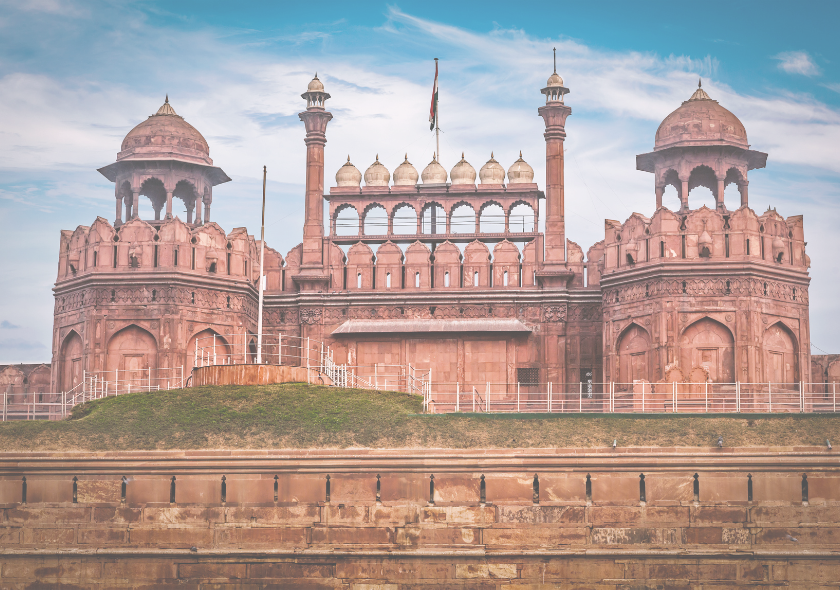
This is a UNESCO World Heritage Site and was the center of Mughal power for over 200 years. It was built by Emperor Shah Jahan—the same man with the same high-end taste who gave the world the Taj Mahal. The red sandstone walls stretch for over a mile, hiding palaces and gardens that once hosted the world’s most powerful rulers.
| Entry (Foreign Nationals) | $5 | ₹500 |
| Entry (Indian Nationals/NRI) | $0.5 | ₹35 |
| Evening Sound & Light Show | $3 | ₹250 |
- Jama Masjid
This is India’s largest mosque, built in 1656, and it can hold 25,000 people at once. While it’s free to enter (just remember to dress modestly), I highly recommend paying the small fee (~$2 / ₹100) to climb the southern minaret. It gives you easily the best view over the rooftops of Old Delhi.
2. New Delhi: The Grand Contrast
- Humayun’s Tomb: Think of this as the “beta version” of the Taj Mahal. It’s a UNESCO site and the architectural ancestor of the Taj. Seeing this first makes you appreciate how Mughal design evolved and refined itself over a century.
| USD | INR | |
| Entry (Foreign Nationals) | ~$7 | ₹600 |
| Entry (Indian Nationals/NRI) | ~$0.3 | ₹40 |
- Qutub Minar: This 73-meter brick minaret is over 800 years old. It’s covered in intricate carvings and stands as a reminder of the very first kingdoms that ruled Delhi.
| USD | INR | |
| Entry (Foreign Nationals) | ~$7 | ₹600 |
| Entry (Indian Nationals/NRI) | ~$0.3 | ₹40 |
- India Gate: The “Arc de Triomphe” of India. It’s best visited in the evening when it’s lit up and the surrounding lawns are filled with local families and street food vendors.
Delhi Practical Notes
- Delhi Metro: Modern, air-conditioned, covers the entire city. Fares: $0.25–$0.75 / ₹20–₹60 per ride. Fastest way to get around. Download the DMRC Momentum app.
- Uber & Ola: Both work seamlessly in Delhi. Far less stressful than haggling with roadside auto-rickshaws for first-timers.
- Currency: $1 ≈ ₹92 (check live rates at xe.com before travel). India is largely cash-based for everyday transactions. Withdraw INR at Indira Gandhi Airport ATMs on arrival, best rates, no commission.
Jaipur: The Pink City’s Palaces, Forts, and Bazaars
Here is something the brochures understate: Jaipur doesn’t just look like royalty. It was royalty, and not that long ago. The Maharaja of Jaipur still lives in part of the City Palace. The forts on the ridge above the city were built to withstand actual armies. The jewellers in Johari Bazaar have been trading gemstones for generations.
In 1876, Maharaja Ram Singh ordered every building in the old city painted terracotta pink to welcome the Prince of Wales and the tradition has held ever since, giving Jaipur a warm, photogenic glow that earns its place on every golden triangle India tour absolutely without argument.
Jaipur carries a particular weight. These palaces and forts were built by Indian kings who commanded armies and commissioned masterpieces. When you stand inside them, you’re not looking at someone else’s history. You’re looking at yours.
- Amber Fort
Eleven miles from the city center, rising dramatically from a ridge above Maota Lake, Amber Fort is the defining monument of Rajput architecture and quite possibly the xmost spectacular fort in all of India. Arrive at 8 am sharp to beat the tour groups.
The Sheesh Mahal (Palace of Mirrors) inside is covered entirely in tiny convex mirror tiles; a single candle scattered across the ceiling creates the illusion of a thousand stars. Your phone camera will completely lose its mind. So will you.
| USD | INR | |
| Entry (Foreign Nationals) | ~$10 | ₹800 |
| Entry (Indian Nationals/NRI) | ~$1.50 | ₹100 |
| Audio Guide | ~$3 | ₹250 |
| Licensed Guide (2 hrs) | ~$12–$15 | ₹1,000–₹1,200 |
- City Palace & Jantar Mantar
The City Palace is a sprawling complex of courtyards, museums, and royal apartments, parts of which are still occupied by the Jaipur royal family today. The adjacent Jantar Mantar is an 18th-century open-air astronomical observatory featuring 19 giant stone instruments capable of tracking celestial bodies with accuracy to within two seconds. It looks like modern conceptual art. It is actually 300 year old science. The combination is one of the most intriguing things on the entire circuit.
- Hawa Mahal (Palace of Winds) The iconic pink honeycomb facade you’ve seen in every photo of India. It was built so royal women could watch street festivals without being seen.
| Combined Ticket (City Palace + Jantar Mantar + Hawa Mahal + Amber Fort) | USD | INR |
| Foreign Nationals | ~$20 | ₹1,800 |
| Indian Nationals/NRI | ~$3 | ₹200 |
Shopping in Jaipur
Jaipur is one of the finest shopping cities in the world — and that is not an exaggeration. Johari Bazaar for gemstone and silver jewellery. Bapu Bazaar for block-printed textiles, leather goods, and Rajasthani handicrafts. Nehru Bazaar for footwear and embroidered bags. Bargaining is expected, appreciated, and part of the experience. Start at 50% of the first asking price and work from there.
Agra: Standing Before the Taj Mahal at Sunrise
Let’s talk about a building that was commissioned in 1631, took 22 years and more than 20,000 workers to complete, required 1,000 elephants to transport marble from across the subcontinent, and still four centuries later manages to exceed every expectation of every person who walks through its gates.
- The Taj Mahal
Taj Mahal was built by Mughal Emperor Shah Jahan as an eternal mausoleum for his wife Mumtaz Mahal, who died in childbirth bearing their fourteenth child. It is the most visited monument in India, one of the Seven Wonders of the Modern World, and a UNESCO World Heritage Site. And none of those facts come close to preparing you for actually standing in front of it.
The white marble changes color with the light. Blue-grey at dawn. Blinding brilliant white at noon. Rose-gold as the sun falls. Every version is different. Every version is extraordinary.
Come at sunrise. Yes, this means a 5am alarm. Yes, you are on vacation. Do it anyway. The gates open at first light, and the first 45 minutes — low golden sun, thin crowds, soft silence — is the version of the Taj Mahal you traveled 8,000 miles for.
| USD | INR | |
| Entry (Foreign Nationals) | ~$15 | ₹1,350 |
| Entry (Indian Nationals/NRI) | ~$0.85 | ₹50 |
| Extra fee for main mausoleum | ~$3 | ₹200 |
| Licensed ASI Guide (2 hrs) | ~$12–$15 | ₹1,000–₹1,200 |
Book tickets in advance without exception. 🔗 Official ASI Booking: https://asi.payumoney.com Tickets sell out on weekends between October and February. Arrive without a pre-booked ticket and the gate stays closed regardless of how far you’ve flown.
The Taj Mahal is closed every Friday.
- Agra Fort
Just 1.5 miles from the Taj, Agra Fort was Shah Jahan’s great palace and later his prison, after his own son staged a coup and locked him inside it. From his chamber window, the Taj Mahal is visible across the Yamuna River. He spent the final eight years of his life staring at it. That detail alone transforms Agra Fort from an impressive monument into something considerably more affecting.
| USD | INR | |
| Entry (Foreign Nationals) | ~$7.50 | ₹650 |
| Entry (Indian Nationals/NRI) | ~$0.85 | ₹50 |
- Fatehpur Sikri
About 25 miles from Agra, an entire Mughal capital city was built, briefly occupied, and then completely abandoned in 1585, left perfectly intact for over 400 years. Walking through its deserted palaces and empty courtyards with almost no other tourists around is one of the most genuinely haunting experiences in northern India.
| USD | INR | |
| Entry (Foreign Nationals) | ~$7.50 | ₹650 |
| Entry (Indian Nationals/NRI) | ~$0.30 | ₹40 |
How to Get Between Delhi, Jaipur, and Agra
- By Private Car (Most Popular for US Visitors)
Most organized golden triangle India packages include a private air-conditioned car with an English-speaking driver for the full circuit. Flexible, door to door, and far more comfortable than coordinating trains across three cities in an unfamiliar country.
| Option | USD | INR |
| Private car + driver (7-day full circuit) | $200–$400 total | ₹17,000–₹33,000 |
| Per-day hire (with driver) | $35–$60/day | ₹2,900–₹5,000/day |
Split between 2 to 4 people, this is outstanding value. Most quality golden triangle tours from Delhi include this as standard.
- By Train
India’s rail network is an experience worth having at least once on your golden triangle trip to India.
| Route | Train | Duration | USD | INR |
| Delhi to Agra | Gatimaan Express | 2 hrs | ~$10 | ₹750–₹900 |
| Agra to Jaipur | Intercity Express | 4 hrs | ~$8 | ₹600–₹800 |
| Jaipur to Delhi | Shatabdi Express | 4.5 hrs | ~$10 | ₹750–₹1,000 |
Book trains at: 🔗 https://www.irctc.co.in Use the Foreign Tourist Quota on IRCTC it reserves a block of seats specifically for international travelers that bypasses the sold-out problem many first-timers encounter.
- By Bus
RSRTC Volvo AC buses connect all three cities reliably. Book at: 🔗 https://www.redbus.in
| Route | Duration | USD | INR |
| Delhi to Jaipur | 5.5 hrs | ~$6–$10 | ₹500–₹800 |
| Jaipur to Agra | 5 hrs | ~$5–$8 | ₹400–₹650 |
Best Time to Visit: Season-by-Season Breakdown
The best time to visit the Golden Triangle is between October and March. If this is your first trip, target November or February for near-perfect conditions.
| Season | Months | Temp (°F / °C) | Verdict |
| Peak (Best) | Oct–Mar | 60°F to 82°F / 15°C to 28°C | Ideal. Blue skies, great light, comfortable sightseeing. |
| Summer (Avoid) | Apr–Jun | 95°F to 115°F / 35°C to 46°C | Brutal. Genuinely dangerous midday heat. |
| Monsoon (Budget) | Jul–Sep | 80°F to 95°F / 27°C to 35°C | Cheaper by 30–40%, lush green, occasional travel delays. |
| Winter Nights | Dec–Jan | Nights: 45°F / 7°C | Pack a jacket for Jaipur evenings. Taj looks stunning. |
Where to Stay on the Golden Triangle Route (All Budgets)
- Delhi
| Category | Hotel | USD/Night | INR/Night |
| Budget | Zostel Delhi, Bloomrooms | $20–$50 | ₹1,650–₹4,150 |
| Mid-Range | The Hans, Hyatt Place, Radisson Blu | $80–$180 | ₹6,600–₹15,000 |
| Luxury | The Imperial, The Leela Palace, Taj Mahal Hotel | $250–$600+ | ₹20,750–₹50,000+ |
For a luxury golden triangle tour India experience, The Imperial on Janpath is the definitive Delhi start, a 1930s colonial landmark that has hosted everyone from world leaders to literary legends.
- Agra
| Category | Hotel | USD/Night | INR/Night |
| Budget | Zostel Agra, Hotel Sheela | $25–$60 | ₹2,000–₹5,000 |
| Mid-Range | Trident Agra, Crystal Sarovar Premiere | $90–$200 | ₹7,500–₹16,600 |
| Luxury | Oberoi Amarvilas | $500–$1,200+ | ₹41,500–₹99,500+ |
Oberoi Amarvilas deserves a sentence of its own: every room has an unobstructed, direct view of the Taj Mahal from your private balcony. Watching the Taj shift from rose-gold to white to moonlit silver without leaving your bed is an experience with no real equivalent anywhere in the world. Worth every rupee, at least once.
- Jaipur
| Category | Hotel | USD/Night | INR/Night |
| Budget | Zostel Jaipur, Moustache Jaipur | $20–$50 | ₹1,650–₹4,150 |
| Mid-Range | Shahpura House, Umaid Mahal | $70–$180 | ₹5,800–₹15,000 |
| Luxury | Rambagh Palace, RAAS Jaipur | $300–$800+ | ₹25,000–₹66,500+ |
Rambagh Palace, a former royal residence converted by the Taj Hotels group, is the most legendary hotel on the golden triangle India circuit. Staying here is as absurdly wonderful as it sounds.
Golden Triangle Itinerary: 5, 7, and 10-Day Options
5-Day Golden Triangle India Itinerary (Fast Track)
- Day 1: Arrive in Delhi. Transfer and rest. Old Delhi evening, Jama Masjid, Chandni Chowk street food.
- Day 2: New Delhi: Red Fort, Humayun’s Tomb, Qutub Minar. Evening Gatimaan Express to Agra.
- Day 3: 5:30 am Taj Mahal sunrise. Agra Fort. Afternoon drive to Jaipur.
- Day 4: Amber Fort, City Palace, Jantar Mantar, Hawa Mahal, bazaar evening.
- Day 5: Morning leisure. Train or drive back to Delhi. International departure.
Best for tight schedules or those adding on a Goa, Kerala, or Mumbai extension.
7-Day Golden Triangle India Tour (Best for Most Travelers)
- Day 1: Arrive in Delhi. Rest, orient, Old Delhi evening food walk.
- Day 2: Full Delhi: Red Fort, Jama Masjid, Humayun’s Tomb, India Gate.
- Day 3: Qutub Minar, Hauz Khas lunch, evening Gatimaan Express to Agra.
- Day 4: Sunrise at the Taj Mahal. Agra Fort. Drive to Jaipur via Fatehpur Sikri.
- Day 5: Full Jaipur: Amber Fort, City Palace, Jantar Mantar.
- Day 6: Hawa Mahal, bazaars, Nahargarh Fort at sunset.
- Day 7: Morning leisure. Drive or train back to Delhi. Departure.
The ideal new Delhi Agra Jaipur tour — spacious enough to absorb each city, tight enough to keep the energy high throughout.
10-Day Golden Triangle Trip India (For Those Who Want Everything)
Add three extra days as follows:
- +1 Delhi: National Museum, Lodhi Garden, Dilli Haat craft market, dinner in Connaught Place.
- +1 Agra: Full-day Fatehpur Sikri excursion. Evening Mehtab Bagh garden the sunset view of the Taj from across the Yamuna River is stunning and far less crowded.
- +1 Jaipur: Tiger safari at Ranthambore National Park ($80–$150 / ₹6,500–₹12,500 per jeep), or day trip to Pushkar holy lakeside town with camel farms and one of India’s most sacred ghats.
Top Tips for First-Time Visitors to Northern India
- Sort your e-Visa 7–10 days early. Apply only at the official portal: 🔗 https://indianvisaonline.gov.in and avoid third-party sites charging inflated service fees.
- Pre-book the Taj Mahal without exception. Book at 🔗 https://asi.payumoney.com. Tickets sell out on weekends in peak season. Don’t show up without one.
- Carry both USD and INR. Most five-star hotels accept cards and USD. For everything else like rickshaws, street food, markets, monument entry you need cash rupees. Current rate: $1 = ₹92. Best withdrawal: airport ATMs on arrival.
- Hire licensed monument guides. Licensed ASI guides at Red Fort, Agra Fort, and Amber Fort typically charge ₹1,000–₹1,200 ($12–$15) for a 2-hour tour. Context transforms impressive old buildings into living history.
- For NRIs bringing American-raised family: Don’t underestimate how powerful this circuit is for people experiencing India through your eyes. The Taj at sunrise, a Rajput fort at dusk, the sensory overload of Old Delhi — these aren’t just sights. For your family, they’re origins. They carry weight that no classroom or family story has quite prepared them for. Give them time to process. Give yourself time too.
Final Thoughts
India didn’t just survive history; it absorbed it. The Golden Triangle is where that story is loudest. Delhi is the ancient heart, Agra is home to a monument no photo can actually capture, and Jaipur is the royal city that never stopped being bold.
For first-timers: it’s louder, brighter, and more beautiful than you’ve heard. It’s worth every second of the flight.
Don’t spend your trip staring at a screen trying to figure out logistics. We believe travel should be personal, not automated.
When you book with us, you get a real human travel agent, not a bot. We handle the boring paperwork and the tricky transport so you can actually enjoy the view.
Quick Reference: Essential Links for US Travelers
| Resource | Link |
| Indian e-Visa (Official) | https://indianvisaonline.gov.in/evisa/ |
| Indian Embassy, Washington D.C. | https://indianembassyusa.gov.in/index |
| Indian Consulate, New York | https://www.indiainnewyork.gov.in/ |
| Indian Consulate, San Francisco | https://www.cgisf.gov.in/ |
| Indian Consulate, Chicago | https://www.cgichicago.gov.in/ |
| Indian Consulate, Houston | https://cgihouston.gov.in/ |
| OCI Re-registration | https://ociservices.gov.in |
| US Embassy Travel Advisory — India | https://in.usembassy.gov/u-s-citizen-services/visiting-india/ |
| Taj Mahal Ticket Booking (ASI) | https://asi.payumoney.com |
| Indian Railways Booking (IRCTC) | https://www.irctc.co.in |
| Bus Booking | https://www.redbus.in |
All Categories
Recent Posts

Cancun Travel Guide 2026 to 2027: Best Time to Visit, Things to Do and Tips

Best Time to Travel to Bali, Indonesia (2026 to 2027): Month by Month Guide
Places to Visit in Jaipur: Top 10 Spots, Ticket Prices and Timings