Route 66 Road Trip Guide: Chicago to LA in 14 Days
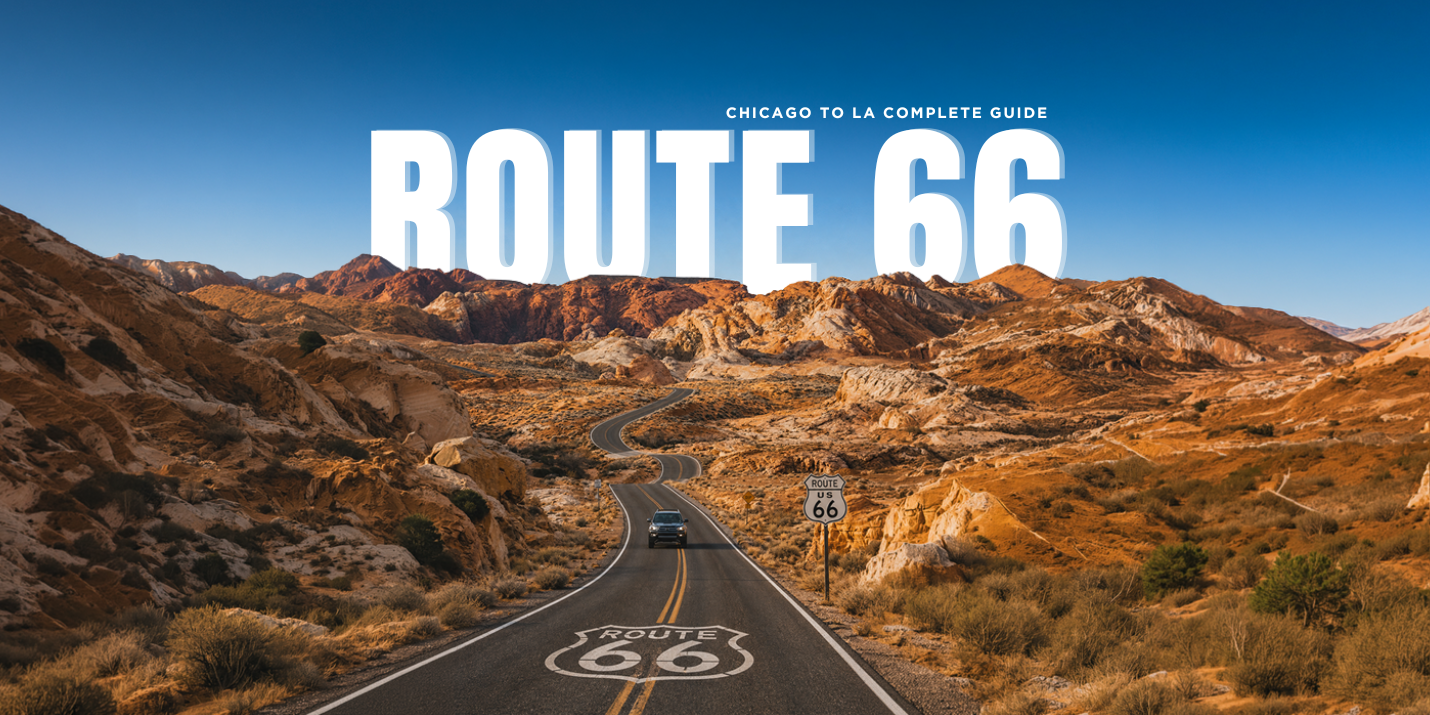
Drive all 2,448 miles of Route 66 in 14 days. Best stops, diners, motels, and car tips from Chicago to Los Angeles with a full packing list and budget guide.
WARNING: THIS ROAD TRIP HAS CAUSED PEOPLE TO QUIT THEIR JOBS, BUY A CONVERTIBLE, AND NEVER FULLY RETURN TO NORMAL LIFE.
Route 66 runs 2,448 miles from Chicago to Los Angeles across eight states. It connects Midwest diners to Arizona deserts, ghost towns to neon-lit motels, and the Great Plains to the Pacific Ocean.
People don’t just drive this road, they remember it. The stops are legendary: Cadillac Ranch, Meteor Crater, the Grand Canyon, a 1950s Mojave diner that flips frozen custard upside down to prove it won’t spill. This guide covers every state, every stop worth making, the best cars to rent, and how many days you actually need. Read this once. Then go.
Route 66 at a Glance
| Total Distance | 2,448 miles (Chicago to Santa Monica) |
| Recommended Duration | 14 days |
| Best Months | April May or September October |
| States Crossed | 8 (IL, MO, KS, OK, TX, NM, AZ, CA) |
| Daily Drive (14 days) | ~175 miles |
| Must-See Stops | 10 (listed in FAQ below) |
| Book Flights & Hotels | GoGo Trips — gogotripsus.com |
Ready to drive the Mother Road?
Route 66: A Brief History of America’s Most Famous Highway
Route 66 opened in 1926. It was one of the first paved highways to connect the Midwest to the Pacific Coast. Chicago through Illinois, Missouri, Kansas, Oklahoma, Texas, New Mexico, Arizona, and into California.Source
The road earned its name in the 1930s. The Dust Bowl destroyed farming across the Great Plains. Around 400,000 families packed their trucks and drove west toward California and whatever work they could find. Route 66 was the road they took. John Steinbeck drove alongside them and wrote The Grapes of Wrath. He called it “the Mother Road.” The name stayed because it was true. source
After World War II, the mood shifted. The 1950s turned Route 66 into something celebratory, with drive-ins, chrome diners, and teenagers going nowhere in particular. Bobby Troup wrote the song in 1946. Nat King Cole recorded it. The road became a symbol.
The interstate system bypassed it town by town through the 1970s. By 1985, Route 66 was officially decommissioned. Signs came down. Many towns nearly disappeared.
But the people along the route refused to let it go. The Historic Route 66 Association formed in a Seligman, Arizona barbershop and fought to keep the diners open and the signs lit. Travelers came back. Then more. Then people from every part of the world.Source
Today it is one of the most driven leisure routes on earth — not because it is fast, but because nothing on the interstate looks like this.
Planning Your Route 66 Road Trip: How Long Does It Take?
The historic route covers 2,448 miles. Here is how different trip lengths actually feel:
| Duration | Daily Miles | Honest Assessment |
| 7 days | ~350 miles | You will see things but not feel them |
| 10 days | ~245 miles | Better. Still slightly rushed through the good parts |
| 14 days | ~175 miles | This is the one. Enough time for the road to actually work on you |
| 21+ days | ~115 miles | For people who already know what this road does to them and want more of it |
14 days is what this guide is built around. It gives you real time in Chicago before you start, room to slow down through New Mexico and Arizona, and a proper finish into Los Angeles rather than a sprint.Source
Which direction: Chicago to Los Angeles is the classic route. The Midwest warms you up, the Plains stretch you out, the desert sharpens everything, and the Pacific is a proper finale. Los Angeles to Chicago works just as well if you fly into LAX.Source
Best time to go: April and May are ideal. Desert wildflowers, manageable temperatures, and fewer crowds. September and October are close seconds. Summer works but start driving by 7 am. Arizona afternoons exceed 110°F. Skip winter for a first trip.
Ready to start planning? GoGo Trips handles flight deals into Chicago O’Hare or out of LAX, hotels along the route, and full vacation packages so you can focus on the drive, not the admin. Book now or call +1 (229) 329-1796.
Chicago to St. Louis: Kicking Off the Journey in the Midwest
The official start is the corner of Adams Street and Michigan Avenue in downtown Chicago. There is a Route 66 Begin sign on the pole. Take the photo. That’s how it starts.
Before leaving, eat. Chicago is one of America’s great food cities and you’re about to spend two weeks at roadside diners. Lou Mitchell’s on Jackson Boulevard has served breakfast since 1923.
Illinois runs at a good pace with real stops worth making.
Pontiac has the Illinois Route 66 Hall of Fame and Museum. Free entry. Better than it sounds. Small-town museums about specific subjects usually are.
Atlanta, Illinois has the Palms Grill Café, a perfectly restored 1930s diner with counter seating, good pie, and the exact atmosphere you pictured when you first heard about this road.
Springfield is Abraham Lincoln’s hometown. The Lincoln Presidential Library and Museum is genuinely world-class. The Cozy Dog Drive In on South 6th Street has claimed to have invented the corn dog since 1946. That’s contested. The corn dogs aren’t.
St. Louis ends the Illinois stretch with the Gateway Arch, which is more graceful in person than any photo suggests, taller and thinner than you expect. Take the tram to the top. Then go to Ted Drewes Frozen Custard on Chippewa Street. It’s been on every Route 66 best stops list for decades and it still belongs there. Get the concrete mixer. They flip the cup upside down. It doesn’t pour. Get two.
Oklahoma, Texas & New Mexico: Wide-Open Spaces and Hidden Gems
Most people underestimate this stretch. They’re thinking about Arizona and the Cadillacs. Oklahoma, Texas, and New Mexico are some of the most memorable miles on the road.
- Oklahoma
Oklahoma City holds one of the most important stops on the Chicago to Los Angeles drive: the Oklahoma City National Memorial, built on the site of the 1995 federal building bombing. It’s quiet, thoughtfully designed, and hits harder than visitors expect. Allow two hours and don’t skip it to make miles.
The Blue Whale of Catoosa is something else entirely. A giant smiling blue whale sits half-submerged in a pond just off the highway, built in the early 1970s by a man for his wife who collected whale figurines. It has been there ever since, inexplicably wonderful. This is what the famous stops on Route 66 are really about. Not everything needs historical significance.
Tulsa has better art deco architecture than most visitors expect, plus the Woody Guthrie Center dedicated to the folk singer who documented the same Dust Bowl families that first filled this road going west.
- Texas
Texas gives you one main stop and it delivers completely: Cadillac Ranch, ten miles west of Amarillo, where ten Cadillacs ranging from model years 1949 to 1963 were planted nose-down in a wheat field in 1974 and have been spray-painted by visitors every single day since, with the layers now several inches thick and a fresh can available at the gas station down the road if you want to add your own which sounds underwhelming until you are actually standing there and realize it is not, at all.
The Big Texan Steak Ranch in Amarillo offers a free 72-ounce steak to anyone who finishes it plus all sides in under an hour. About 12% of people succeed. Watching the rest is free and extremely entertaining.
- New Mexico
New Mexico is where the landscape makes its first serious move. Red mesas appear on the horizon. The sky goes deeper blue. Adobe buildings line the road. Everything starts feeling ancient in a way that’s hard to name but immediately obvious when you get there.
Santa Fe is a 90-minute detour north of the main route and worth every minute. Oldest state capital in the country. The Museum of International Folk Art is extraordinary. The food is some of the best on the entire circuit. Give it a full day if you have one.
Albuquerque’s Central Avenue runs through the city on the original Route 66 alignment. Drive through Nob Hill at dusk, the preserved neon signage from the 1950s lights up every evening and looks exactly as good as it sounds.
Tucumcari delivers more atmosphere than its size suggests. The Blue Swallow Motel, built in 1939, is still operating, with its original neon sign still working, and is one of the best overnight stops on the whole route. The rooms aren’t fancy. The experience is.
The Blue Swallow and other iconic Route 66 stays book up fast in peak season. GoGo Trips can handle your hotel bookings along the entire route from Tucumcari to Flagstaff to Pasadena so you are not scrambling for a room in Amarillo at 9pm after a long day on the road.
Arizona Highlights: Petrified Forest, Meteor Crater & the Grand Canyon Detour
Arizona is where the trip peaks visually. Stop saving space on your camera.
- Petrified Forest National Park
Near Holbrook, just off Route 66, Petrified Forest holds 225-million-year-old fossilized trees scattered across the Painted Desert in deep reds, pale purples, and burnt oranges that look edited rather than real. The 28-mile scenic drive costs $25 per vehicle. Give it two to three hours. It’s one of the genuine must-see stops on the route.Source
- Meteor Crater
About 43 miles east of Flagstaff, a meteor struck 50,000 years ago and left a crater nearly a mile wide and 560 feet deep. Standing on the rim recalibrates your sense of scale in a way that stays with you for the rest of the day. Entry is $22. The rim walk takes about an hour.
- Flagstaff and the Grand Canyon
Flagstaff sits at 7,000 feet in a ponderosa pine forest, which surprises people who picture Arizona as an entirely flat desert. Good craft beer, college-town energy, and the best base for the Grand Canyon.
The Grand Canyon is 90 minutes north and not technically on the Route 66 map. It is also one of the Seven Natural Wonders of the World. Give it a full day. Walk at least a mile down the Bright Angel Trail. The canyon from inside looks completely different from the rim view, and the rim, as spectacular as it is, is not the full experience.
Williams was the last Route 66 town bypassed by the interstate in 1984. Seligman is where the Historic Route 66 Association started Angel Delgadillo’s barbershop, still open, the man himself occasionally there, and the town most credited with inspiring the movie Cars. Both are worth stopping in. Seligman especially.
Spending a full day at the Grand Canyon means you need a solid Flagstaff base. GoGo Trips can book your Flagstaff hotel alongside your flights into Phoenix or Las Vegas, so the Grand Canyon detour fits cleanly into your itinerary without any awkward logistics.
California Stretch: The Mojave Desert to the Pacific Ocean
Entering California from Arizona, the landscape shifts into the Mojave. Joshua trees appear on the hillsides. Everything turns slightly more cinematic as if the road knows it’s nearly over and wants to give you one last thing.
Amboy is a ghost town on one of the longest surviving original Route 66 alignments on the drive. Roy’s Motel and Café, a 1950s roadside stop with its original googie-architecture sign still standing, is one of the most photographed locations on the entire road. Stop at the sign.
Barstow is the last real town before the LA basin. The Route 66 Mother Road Museum in the restored Harvey House railway station is free and one of the better small museums on the circuit. Worth an hour.
Then the road runs into suburban Los Angeles strip malls, traffic, and everything the previous 2,300 miles was not. You’ve earned it. The contrast feels right.
The end is the Santa Monica Pier, specifically the End of the Trail sign at the far western edge where the Pacific begins. Stand there for a minute. You drove from Chicago. Let that register.
Best Stops, Diners, and Roadside Attractions Along Route 66
Some of the best things to see on Route 66 are historically significant. Some are just delightfully inexplicable. The best ones tend to be both.
- Diners that are genuinely worth the stop:
Lou Mitchell’s in Chicago since 1923, breakfast only, cash only, line usually, worth it always. Palms Grill Café in Atlanta, Illinois for the best-preserved diner atmosphere on the Illinois stretch. The Midpoint Café in Adrian, Texas at the exact geographic halfway point of the whole route, serving something called ugly crust pie that tastes much better than its name. Joe and Aggie’s Café in Holbrook, Arizona, since 1943 the green chile is not optional. Emma Jean’s Holland Burger in Victorville, California, which is a no-frills diner that does everything right.
- Roadside attractions that deliver:
Cadillac Ranch in Amarillo. The Blue Whale of Catoosa in Oklahoma. The Wigwam Motel in Holbrook where the rooms are shaped like concrete wigwams and it is both absurd and genuinely fun. The Painted Desert. Meteor Crater. Roy’s in Amboy. The End of Trail sign in Santa Monica.
- Overnight stops worth booking in advance:
Blue Swallow Motel in Tucumcari, New Mexico, the single most atmospheric overnight on the route. Wigwam Motel in Holbrook. Saga Motor Hotel in Pasadena for the last night before Santa Monica, vintage neon, walkable neighborhood.
What Car to Rent for a Route 66 Road Trip
The car matters here in a way it does not on most trips. This is not a rational observation but it is accurate.Here is a practical comparison to help you decide:
| Vehicle Type | Pros | Cons | Best For |
| Midsize SUV / Crossover | Comfortable over long days, good cargo space, handles unpaved sections | Less atmospheric, higher fuel cost | Families, couples with heavy luggage, first-timers |
| Mustang Convertible | The definitive Route 66 experience through Arizona and the Mojave | Less storage, AC strain in extreme heat | Couples, solo drivers, the version of the trip you describe for years |
| Economy Car | Lowest cost | AC strain in Mojave summer heat, underpowered on grades | Short sections only, not recommended for the full route in summer |
| Camper Van / RV | Self-contained, no motel booking pressure | Parking challenges at some stops, higher fuel cost | Those wanting maximum flexibility on a longer timeline |
For most people a midsize SUV or crossover is the right practical answer. Comfortable over long daily distances, enough cargo room that packing and unpacking motels does not become a daily puzzle, handles the occasional unpaved historic alignment section. Budget $60 to $120 per day, depending on the rental company and season.
For the version of the trip that people describe for years afterward: a Mustang convertible, specifically through Arizona and the Mojave, where the combination of open air and empty highway and warm desert is exactly what every Route 66 road trip guide has been describing since 1946 and is accurate. Rather than hunting down rental platforms yourself, contact GoGo Trips and the team will sort the right vehicle for your route, dates, and budget so you show up in Chicago ready to drive, not still comparing options online.
One practical point: in summer, avoid underpowered economy cars for the Mojave crossing. The AC runs constantly at 110 degrees and small engines and transmission systems are not always up to the sustained demand. Get something with a proper cooling system.
Fuel budget for the full Chicago to LA road trip: roughly $300 to $500 in a standard vehicle at current prices.
Route 66 Packing List and Practical Travel Tips
- A physical road map. Cell service disappears in rural Oklahoma, eastern New Mexico, and long Mojave stretches with zero warning. A Route 66 atlas from any travel bookshop does not lose signal. It is the single most useful thing in the bag that people forget to pack.
- A car cooler. In Arizona in summer, cold water is not a preference, it is a requirement. Filling a cooler with ice at each stop costs nearly nothing and keeps you functional through the afternoon heat in a way that buying expensive convenience store water does not.
- Cash. A surprising number of the best stops on Route 66 are cash-preferred or cash-only. The ATM situation in small New Mexico and Oklahoma towns is not reliable. Carry a few hundred dollars in mixed bills.
- Sunscreen and lip balm. The desert sun at altitude is not comparable to the sun you are used to. SPF 50 minimum. Apply it in the morning before you get in the car, not when you are already standing in a crater in Arizona at noon.
- A portable jump starter. If something goes wrong between Tucumcari and Amarillo, the nearest roadside assistance is coming from far away. A jump starter in the trunk is a $50 insurance policy that has salvaged many trips.
- Audiobooks and podcasts. The Texas Panhandle stretch on the route 66 road trip guide is long and flat and magnificent in its own way but it requires content. Download before you get there because streaming is not guaranteed.
Book motels in Flagstaff, Santa Fe, and Amarillo in advance for summer travel. These fill up. Everything else is generally fine day-of in spring and fall.
Frequently Asked Questions About the Route 66 Road Trip
How long does it take to drive Route 66 from Chicago to Los Angeles? The full route covers 2,448 miles and can technically be driven in 7 days, but 14 days is the sweet spot that most experienced Route 66 travelers recommend.
What is the best time of year to drive Route 66? April and May are the ideal months, offering desert wildflowers, manageable temperatures across all eight states, and noticeably fewer crowds at the major stops. September and October are close seconds. Summer is doable but Arizona afternoons regularly exceed 110°F, so plan to start driving by 7am. Avoid winter for a first trip, as some smaller stops and motels operate reduced hours or close entirely.Source
Which direction should I drive Route 66, Chicago to LA or LA to Chicago? Chicago to Los Angeles is the classic direction and the one this guide is built around, because the landscape progression feels earned. The Midwest eases you in, the Plains open you up, the desert sharpens everything, and the Pacific is a proper finish. That said, Los Angeles to Chicago works just as well logistically, particularly if you are flying into LAX.
What is the best car to rent for a Route 66 road trip? For most people a midsize SUV or crossover is the right practical answer which is comfortable over long distances, enough cargo space for two weeks of luggage, and capable on the occasional unpaved historic alignment.
Do I need to book motels in advance for Route 66? For spring and fall travel, most stops are fine to book day-of except Flagstaff, Santa Fe, and Amarillo, which fill up and should be reserved in advance. For summer travel, book all major overnight stops ahead of time, particularly the iconic ones like the Blue Swallow Motel in Tucumcari and the Wigwam Motel in Holbrook, which have limited rooms and loyal repeat visitors. GoGo Trips can manage your hotel bookings along the entire route so you are never scrambling for a room at 9pm after a long day on the road.
What are the must-see stops on Route 66? If you had to choose ten, they would be: the Route 66 Begin sign in Chicago, Ted Drewes Frozen Custard in St. Louis, the Oklahoma City National Memorial, the Blue Whale of Catoosa, Cadillac Ranch in Amarillo, the Blue Swallow Motel in Tucumcari, Petrified Forest National Park, Meteor Crater, the Grand Canyon (a 90-minute detour from Flagstaff and non-negotiable), and the End of Trail sign at the Santa Monica Pier. Everything else on this guide is a bonus on top of those ten.
Is the Grand Canyon on Route 66? Not technically, the Grand Canyon is a 90-minute detour north of the main Route 66 alignment near Flagstaff. It is also one of the Seven Natural Wonders of the World, so skipping it to stay on the official route would be a decision most people regret. source
Is Route 66 still drivable in 2025? Yes, the majority of the historic alignment is still intact and drivable, though some sections have been replaced by interstate highway. The most scenic and historically significant stretches including long sections through Oklahoma, New Mexico, and the Mojave, remain on original alignment and are accessible by car.
Final Thoughts
Two weeks from now you could be standing at the Santa Monica Pier watching the sun drop into the Pacific, trying to figure out how to explain to someone who was not there what the last fourteen days actually felt like.
You will probably say something like “it was amazing,” and that will be completely inadequate and you will know it. The best route 66 travel guide in the world cannot give you the specific feeling of the New Mexico desert at 5pm when the light goes golden and the road runs straight to the horizon and there is nothing in any direction that needs anything from you. That part is the trip’s to give.
But this guide can get you on the road with the right car, the right stops, and enough time to actually feel it rather than just complete it. That is the whole job.
The Mother Road is not going to drive itself.
Go in spring, go in fall or go whenever works, but go. One Chicago to Los Angeles road trip done slowly with the windows down. Fourteen days, eight states. The kind of memories that show up uninvited for years.
GoGo Trips makes the pre-trip easy so the road trip can be everything it is supposed to be. Flights into Chicago or out of Los Angeles, hotels along the route, and full vacation packages built around your dates. Book now at gogotripsus.com or call +1 (229) 329-1796 to talk to a travel expert who will sort the logistics while you plan the playlist.
All Categories
Recent Posts

Cancun Travel Guide 2026 to 2027: Best Time to Visit, Things to Do and Tips

Best Time to Travel to Bali, Indonesia (2026 to 2027): Month by Month Guide
Places to Visit in Jaipur: Top 10 Spots, Ticket Prices and Timings