Prague Travel Guide 2026: Best Things to Do, Where to Stay, and How Many Days You Need
Prague Travel Guide 2026: Best Things to Do, Where to Stay, and How Many Days You Need
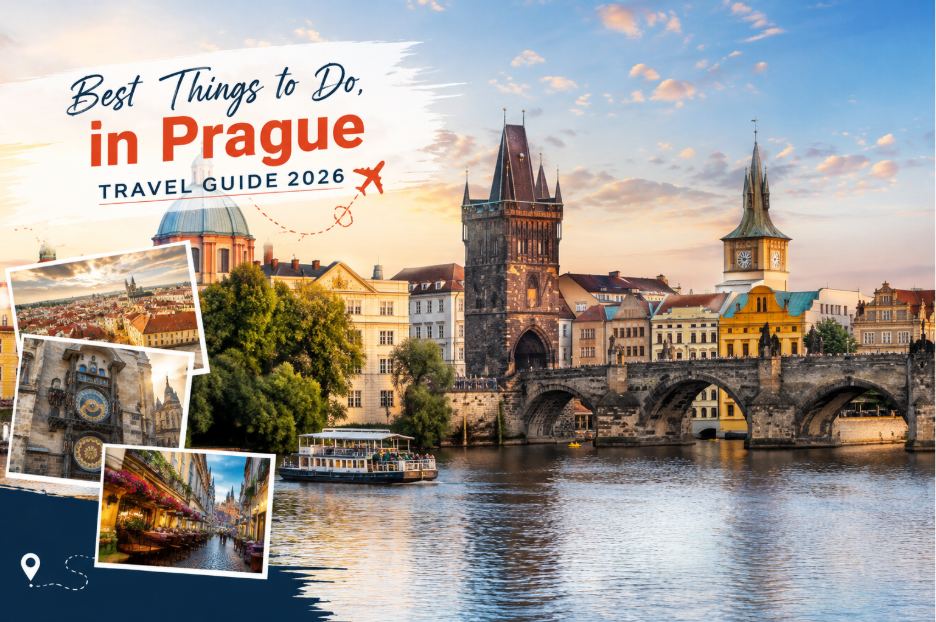
Prague ranks as one of the most walkable, affordable, and photogenic capitals in Europe. Prague tourism has grown steadily, and the city now welcomes over 8 million visitors a year, with more Americans choosing it as a first-time Europe destination every trip season. If you’re visiting Prague for the first time, this guide gives you everything you need. It covers what to do in Prague, the best time to go, how many days to spend, top attractions, hidden gems, day trips, food, safety, and money-saving tips written for first-time explorers from the USA.
Planning a quick Prague weekend trip or a full week in the Czech Republic? Here’s what you actually need to know.
Quick Prague Facts for First-Time Visitors
| Currency | Czech Koruna (CZK) — not the Euro |
| Best time to visit | May, June, September, October |
| Ideal trip length | 3–4 days (add a day for a day trip) |
| Language | Czech; English is common in tourist areas |
| Airport | Václav Havel Airport Prague (PRG), 17 km from Old Town |
| Safety level | Very safe — U.S. State Department Level 1, “Exercise Normal Precautions” |
| Daily budget | $75–90/day (budget) · $150–220/day (mid-range) · $300+ (luxury) |
Who Travels to Prague (and Who This Guide Is For)
Recent tourism data shows couples make up the largest share of visitors at roughly 39%, followed by families at about 33%, solo travelers at 19%, and groups of friends at 14%. The United States sits among the top three international source markets for Prague, alongside Germany and the UK.
Most travelers who search for this guide fall into one of these groups:
- Couples in their late 20s to 40s.
They plan a romantic city break, or a honeymoon stop on a wider Europe trip.
- Families with kids.
They want a safe, walkable city with castles, boat rides, and short travel days between sights.
- Solo travelers and young adults (21–35).
They come for Prague’s nightlife, beer culture, and affordable bachelor or bachelorette weekends. Prague has long ranked as one of Europe’s top stag and hen party destinations. If you’re after crazy things to do in Prague or just fun things to do for a young-adult group trip, think beer spas, escape rooms, shooting ranges, and pub cruises along the Vltava.
- First-time Europe travelers of any age.
They want a budget-friendly, English-friendly entry point before they explore the rest of the continent.
Best Time to Visit Prague
The best time to visit Prague is May, June, September, or October. The weather in Prague during these shoulder-season months brings comfortable temperatures (59–72°F), smaller crowds than peak summer, and lower hotel prices.
- Spring (April–June): Castle gardens bloom; the Prague Spring International Music Festival runs, and the weather stays mild. Pack layers — a sunny 60°F afternoon can drop to 45°F by evening.
- Summer (July–August): You’ll get the warmest weather (68–82°F), but also the biggest crowds. Charles Bridge and Prague Castle get packed, and hotel rates run 40–50% higher than the shoulder season. Expect short afternoon thunderstorms.
- Fall (September–October): You’ll find comfort like spring, plus fall colors in the royal gardens and 25–35% lower hotel costs than summer.
- Winter (November–March): This is the cheapest Prague travel season. Hotel rates drop 40–55% below summer peaks. December brings the famous Christmas markets to Old Town Square. January and February stay quiet and cold — perfect if you want the castle and Charles Bridge to yourself.
How Many Days in Prague Do You Need?
Wondering how many days to spend in Prague? Plan for 3 to 4 days in Prague if this is your first visit. Three days covers the essentials — Prague Castle, Old Town, Charles Bridge, and the Jewish Quarter. A fourth day lets you add a day trip like Kutná Hora or Karlštejn Castle without rushing.
What to see in Prague in 3 days:
- Day 1: Old Town Square, the Astronomical Clock, Charles Bridge, and Malá Strana
- Day 2: Prague Castle, St. Vitus Cathedral, Golden Lane, and Petřín Hill
- Day 3: Jewish Quarter, a Vltava River cruise, and a local neighborhood like Vinohrady or Žižkov
If you have five or more days, use the extra time for Kutná Hora or Český Krumlov. Both need a half or full day to reach and explore, so they work best once you’ve settled into a longer Prague itinerary rather than a quick weekend one.
Is Prague Safe for American Tourists?
Yes. Prague ranks as one of the safest capital cities in Europe. The U.S. Department of State rates the Czech Republic Level 1 — Exercise Normal Precautions, its lowest and safest advisory tier, with no specific warning against travel.
Keep these Prague tips for tourists in mind:
- Watch for pickpockets, not violence. Petty theft is the real risk in crowded spots like Charles Bridge, Old Town Square, and the metro. Keep your bag zipped and in front of you.
- Skip the street currency exchange booths. Kiosks near Old Town Square and Wenceslas Square often quote rates 15–25% worse than a bank ATM.
- Book rides through Bolt or Uber instead of hailing street taxis, especially from the airport or train station, where unmarked cabs sometimes overcharge tourists.
- Solo female travelers and families both rate Prague as very safe. The city has a low violent crime rate compared to other major European capitals.
- Skip the park outside the main train station (Hlavní nádraží) after dark. It isn’t dangerous, but locals agree it’s not worth your time.
Prague Travel Cost: What to Budget
Travel costs in Prague runs noticeably lower than Paris, London, or Amsterdam. That’s one reason it’s become such a popular first Europe stop for Americans.
- Budget travelers: about $75–90/day, covering a hostel or basic hotel, simple lunches, and public transport
- Mid-range travelers: $150–220/day, covering a comfortable hotel, restaurant dinners, and paid attractions
- Luxury travelers: $300+/day for high-end hotels and fine dining
A few real prices to set expectations: a half liter of Czech beer at a local pub costs about $2–3 (45–70 CZK), a sit-down dinner (svíčková or goulash with dumplings) runs $7–10, and a 24-hour public transport pass costs around $6.
Money tip: the Czech Republic uses the Czech Koruna (CZK), not the Euro — a common surprise for first timers, since the country belongs to the EU. In 2026, $1 buys roughly 23–25 CZK, though rates shift daily. Pull cash from a bank ATM (Česká spořitelna or Komerční banka work well) instead of private exchange kiosks or airport counters, which usually offer worse rates. Most places accept cards, so you’ll rarely need a lot of cash.
Getting from the Airport and Getting Around
Václav Havel Airport Prague (PRG) sits about 17 km (30–40 minutes) from the city center. Most Americans fly in through a connection in London, Amsterdam, Frankfurt, or Paris, though seasonal direct flights from the U.S. East Coast — including a new Philadelphia–Prague route launched in 2026 — now cut travel time for East Coast travelers.
From the airport, pick one of these options:
- Airport Express bus to the main train station — the cheapest choice, about 40 minutes
- Pre-booked private transfer — fixed price, driver waits at arrivals, best if you’re carrying luggage or arriving late
- Bolt or Uber — book from your phone the moment you land
Once you’re in the city, you can walk to most of the historic center. The tram and metro network runs cheap and simple, even if you don’t speak Czech.
Where to Stay in Prague for First-Time Visitors
If you’re wondering where to stay in Prague as a first-time visitor, it comes down to how much walking you want versus how quiet you want at night.
- Staré Město (Old Town): The most central choice, steps from the Astronomical Clock and Charles Bridge, but also the busiest and priciest.
- Malá Strana (Lesser Town): Quieter and cobblestoned, sitting right below Prague Castle with easy access to Charles Bridge.
- Vinohrady: A leafy, residential area popular with locals. It has a strong restaurant scene and sits on a short tram ride from downtown — a great pick if you want a less touristy base.
- Nové Město (New Town): Home to Wenceslas Square and the main train station, with good-value hotels and strong transport links.
For a first trip, choose Malá Strana or Vinohrady. Both balance walkability, atmosphere, and value well.
Best Things to Do in Prague: Top Attractions
Here are the top 10 things to do in Prague — the essentials to cover before you branch out into anything more niche.
1. Prague Castle
Guinness World Records lists Prague Castle as the largest ancient castle complex on Earth, and it dominates the skyline above the Vltava River. The grounds stay open daily from 6 a.m. to 10 p.m., free to walk through. The historic interiors (Old Royal Palace, Golden Lane, and St. Vitus Cathedral) open 9 a.m.–5 p.m. in summer (April–October) and 9 a.m.–4 p.m. in winter (November–March). The Basic Tour ticket, which covers all major interiors, costs 450 CZK (about $18–20) per adult. Catch the Changing of the Guard ceremony at noon at the main gate. Visit Prague Castle at night too — the complex stays lit and open until 10 p.m., and it’s noticeably quieter after sunset.
2. St. Vitus Cathedral
St. Vitus Cathedral sits inside the Prague Castle complex. It’s the largest and most important church in the country, with soaring Gothic spires and stained-glass windows. One window was designed by Art Nouveau artist Alphonse Mucha. Your ticket comes bundled into the Prague Castle Basic Tour ticket rather than sold separately. Book a guided tour if you want the history explained in depth instead of walking through on your own.
3. Charles Bridge and Old Town Square
Walk the pedestrian-only Charles Bridge to connect Malá Strana with Old Town Square Prague, the historic heart of the city. Builders finished the bridge in 1402, and it’s still lined with 30 baroque statues today. In the square, watch the medieval Astronomical Clock (the Orloj), the oldest working astronomical clock in the world. It puts on an animated hourly show with a walk of the twelve apostles.
Old Town and the Jewish Quarter
Wander the cobblestone lanes of Staré Město and the neighboring Jewish Quarter (Josefov). This district holds some of Europe’s oldest surviving synagogues and the historic Old Jewish Cemetery.
5. Letná Park
Head to Letná Park for one of the best free views in the city. This hilltop green space sits across the river from Old Town. It holds a giant functioning metronome, built on the site of a former Stalin monument, plus a beer garden with sweeping skyline views. Locals treat it as a favorite evening spot.
6. A Vltava River Cruise
Take a Prague River cruise to see the castle, Charles Bridge, and the National Theater from the water. Basic sightseeing cruises start around $16–18 for about an hour, while a boat cruise in Prague with lunch or dinner (usually buffet-style, often with live music) starts around $56. For the best Prague river cruise experience, book an evening cruise and see the city lit up after dark.
7. City Sightseeing by Hop-On Hop-Off Bus
Short on time? A hop-on hop-off Prague bus tour is the easiest way to see the city fast. It covers the major sights — Prague Castle, Old Town, Wenceslas Square, and Vyšehrad — at your own pace. Hop off wherever catches your eye.
8. Prague’s Art Galleries and Museums
Beyond the historic sights, Prague’s art galleries and museums deliver real depth. The National Gallery spans medieval to modern art. The DOX Centre for Contemporary Art rewards the trip out to Holešovice. The Museum of Communism explains the country’s 20th-century history clearly.
9. John Lennon Wall
Find this ever-changing graffiti wall in the Kampa district near Charles Bridge. It became a symbol of free speech during Communist rule, and visitors still repaint it with messages and art today.
10. Vyšehrad
Visit this quieter fortress complex south of downtown for panoramic river views. A historic cemetery here holds the grave of composer Antonín Dvořák. It’s a great pick if you want castle-level views without castle-level crowds.
These ten spots come up again and again in traveler reviews, Reddit threads, and local guides — the kind of must-do list that holds up whether you’re in Prague for two days or two weeks.
Hidden Gems in Prague
Once you’ve covered the essentials, these hidden gems in Prague turn a good trip into a great one:
- Vinohrady’s café and restaurant scene — a locals-first neighborhood with far fewer tourists than Old Town
- Karlín — a converted industrial district full of hip cafés (like Eska) that most first-timers skip entirely
- Žižkov and the TV Tower — a brutalist 216-meter tower with crawling baby sculptures and panoramic city views, plus the beer garden at Riegrovy Sady park
- The Devil’s Channel (Čertovka) — a narrow canal in Malá Strana nicknamed “Prague’s Venice,” best seen on a small-boat tour
- Náplavka riverside — a stretch of the Vltava embankment that turns into an open-air farmers’ market on weekends and a laid-back bar scene most evenings
Best Day Trips from Prague
Prague’s location gives you a huge advantage: within two to three hours, you can reach some of the most striking towns and castles in the Czech Republic. Here are the best day trips from Prague:
- Kutná Hora (about 1 hour by train): Visit this UNESCO World Heritage silver-mining town and see the Sedlec Ossuary, or “Bone Church.” This chapel holds the bones of roughly 40,000 people. Most travelers rank it the single best day trip from Prague.
- Karlštejn Castle (about 40 minutes by train): Tour this dramatic Gothic castle, built by Emperor Charles IV to house the crown jewels and holy relics — an easy half-day trip.
- Český Krumlov (2.5–3 hours by bus or train): Explore this fairy-tale UNESCO-listed medieval town, built around a bend in the Vltava River with its own hilltop castle. It needs a longer day (or an overnight stay), but travelers consistently rate it one of the most beautiful towns in Europe.
- Karlovy Vary (about 1.5–2 hours by bus): Relax in this elegant 19th-century spa town, known for mineral hot springs and colonnades — a calm contrast to Prague’s busier pace.
Book tickets for popular sites like the Bone Church or Karlštejn’s Chapel of the Holy Cross in advance, especially on weekends in peak season. Time slots do sell out.
Prague Food, Restaurants, and Drinks
Prague restaurants range from budget pub food to Michelin-starred tasting menus, and food ranks among the best values on a Czech trip.
- What to try: Svíčková (marinated beef in cream sauce with bread dumplings), guláš (Czech goulash), smažený sýr (fried cheese), and knedlíky (Czech-style dumplings)
- Best places to eat in Prague: Walk two or three streets away from Old Town Square for an authentic, less touristy meal. Prices drop noticeably, and the food often improves. Locals favor neighborhood spots in Vinohrady and Žižkov for exactly this reason.
- Cost of beer in Prague: A half-liter of Czech lager costs about $2–3 (45–70 CZK) at a local pub, versus $5–7 at a tourist-area bar on Old Town Square. Czech beer culture runs deep — Plzeň, a city nearby, invented Pilsner-style lager in 1842.
- Best street food in Prague: Grab a trdelník from a stand in Old Town — the spiral sugar-and-cinnamon pastry sold throughout the city. Worth knowing: this isn’t a traditional Czech dish. It has Central European roots but became a popular tourist-street snack rather than a historic Prague food.
- Best places to drink in Prague: Try traditional beer halls in Žižkov, rooftop bars with castle views in Malá Strana, and riverside bars along the Náplavka embankment.
- Prague cafes: The city runs on a strong café culture, especially in Vinohrady and New Town, ranging from historic Art Nouveau coffeehouses to modern specialty roasters.
- Book a guided Prague food tour to sample multiple neighborhood spots in one outing with a local who knows which menus to skip.
Fun Facts About Prague
A few fun facts about Prague worth knowing before you go:
- Locals call Prague the “City of a Hundred Spires” for its dense skyline of Gothic and Baroque church towers.
- The Astronomical Clock in Old Town Square, installed in 1410, still runs today — the oldest astronomical clock in the world still in operation.
- Guinness World Records recognizes Prague Castle as the largest ancient castle complex on Earth.
- The Vltava River, which flows through the city, runs roughly 430 km (267 miles) — the longest river entirely within the Czech Republic.
- Prague’s historic center survived World War II with almost no bombing damage. That’s why so much of its medieval and Baroque architecture still stands today, unlike most major European capitals.
FAQ
How many days do I need in Prague?
Plan for three to four days if this is your first visit. Three days cover the essential sights, and a fourth day gives you time for a day trip like Kutná Hora or Karlštejn Castle.
Is Prague safe for American tourists?
Yes. The Czech Republic carries the U.S. State Department’s lowest advisory level (Level 1, Exercise Normal Precautions), and Prague has a low violent crime rate. Watch for pickpockets in crowded tourist areas and currency exchange scams — both are easy to avoid.
What is the best time to visit Prague?
Choose May, June, September, or October for the best mix of comfortable weather, manageable crowds, and reasonable prices. July and August run warmest but busiest and most expensive. December through February stay cheapest and quietest, aside from the Christmas market season.
Does Prague use the Euro?
No. The Czech Republic uses the Czech Koruna (CZK), even as an EU member. Pay in koruna rather than euros whenever you can for the best value.
Is Prague expensive?
Prague costs less than Western European capitals like Paris or Amsterdam. Budget travelers can expect to spend around $75–90 per day, while mid-range travelers typically spend $150–220 per day.
What is the best day trip to Prague?
Most travelers pick Kutná Hora as the best day trip from Prague — about an hour away by train, home to the UNESCO-listed Sedlec Ossuary (the “Bone Church”) and a charming medieval town center.
Do I need a visa to visit Prague from the USA?
U.S. citizens can visit the Czech Republic and the Schengen Area visa-free for stays up to 90 days. As of 2026, U.S. travelers also need to register for ETIAS authorization online before departure.
What should I pack for Prague?
Pack comfortable walking shoes — Prague’s Old Town runs entirely on cobblestone. Bring layers regardless of season, since mornings and evenings stay cooler than midday even in summer.
Planning a first trip to Europe and want Prague to build into a wider itinerary? Go-Go Trips put together custom Europe tours that combine Prague with other Central European highlights. See how it works on our East European Wonders tour, which includes guided time at Prague Castle, St. Vitus Cathedral, and Charles Bridge as part of a multi-country route.
Read more:
best time to plan a Europe trip from the USA ·
how to plan a multi-country Europe itinerary
Ready to book your Prague trip? Talk to a Go-Go Trips travel expert to build flights, hotels, and guided tours around your dates.
All Categories
Recent Posts

Cancun Travel Guide 2026 to 2027: Best Time to Visit, Things to Do and Tips

Best Time to Travel to Bali, Indonesia (2026 to 2027): Month by Month Guide
Places to Visit in Jaipur: Top 10 Spots, Ticket Prices and Timings