Greek Islands Travel Guide 2026: Best Islands, Beaches & Things to Do
Greek Islands Travel Guide 2026: Best Islands, Beaches & Things to Do
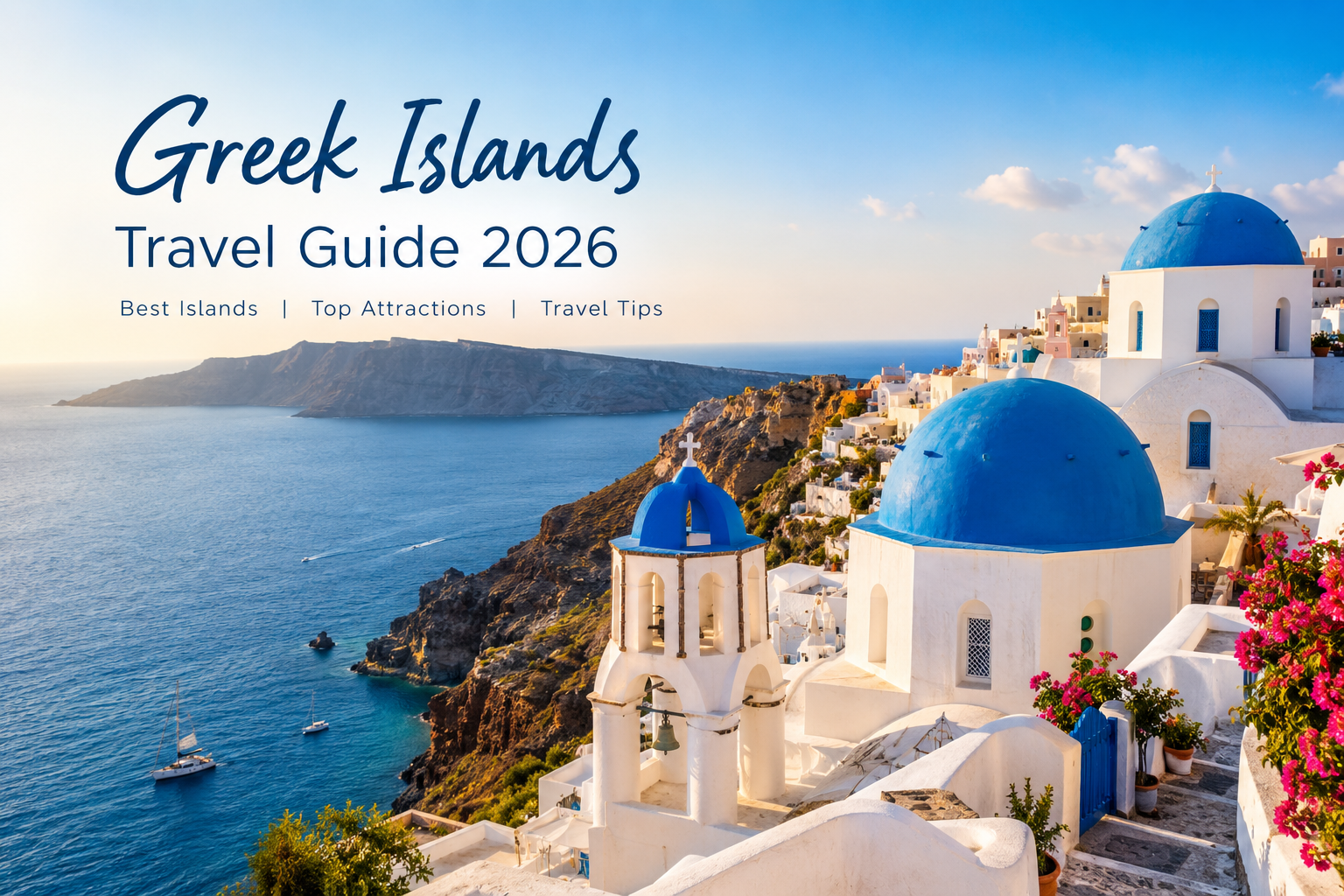
Planning a trip to the Greek islands? This guide covers the best islands to visit, the best beaches, when to go, how to get there, and the 2026 rules that a lot of older guides still get wrong including the new tourist taxes and what’s actually open at Navagio Beach.
Quick answer: The best time to visit is late May–June or September–early October. The best all-round first-trip islands are Santorini, Naxos, and Paros. A week is enough for three islands; ten days lets you add a fourth.
In This Guide
- Best time to visit
- What a trip actually costs
- Getting to Greece
- How island hopping works
- Best islands to visit in 2026
- Which island fits your trip
- Best beaches
- Best things to do
- Getting around once you’re there
- What’s new for 2026: taxes, entry rules, safety
- Sample itineraries
- Practical tips
- FAQ
Best Time to Visit the Greek Islands
The best time to visit is late May through June, and September into early October. You get warm, swimmable seas, reliable sun, and hotel prices roughly 25–50% lower than peak summer.
| Season | Months | What to expect |
| Shoulder (best value) | Late May–June, Sept–early Oct | Warm days, thinner crowds, everything open, lower prices |
| Peak | July–August | Hottest (82–95°F / 28–35°C), busiest, priciest. The meltemi wind picks up mid-July to mid-August |
| Off-season | November–March | Cheapest, but small-island ferries and hotels wind down. Better suited to Athens, Crete, and Rhodes |
A few things worth knowing:
- August and September have the warmest sea water, around 75°F (24°C).
- Crete has the longest season. Its south coast stays warm into October and November.
- Greek Orthodox Easter (April 10–13, 2026) can disrupt ferry schedules. Plan around it if your trip overlaps.
- For Santorini specifically, go in late May, June, or September to see the caldera without August’s crowds.
What Does a Greek Islands Trip Actually Cost?
Costs vary a lot by island and season. As a rough daily guide per person, outside July–August:
| Style | Daily budget | What it gets you |
| Budget | $60–90 | Hostel or basic room, local tavernas, public buses/ferries |
| Mid-range | $120–200 | 3-star hotel, mix of tavernas and nicer meals, some day tours |
| Higher-end | $300+ | Boutique hotel or caldera-view suite, private boat tours, car rental |
Naxos, Milos, and Crete are noticeably cheaper than Santorini and Mykonos for food and lodging. Ferries between nearby islands typically run €25–50 per person one-way; domestic flights from Athens run roughly €60–150 depending on how far ahead you book.
Getting to the Greek Islands
There are no nonstop flights from anywhere to a Greek island directly — every international flight lands in Athens (ATH), and you connect from there.
From the United States
Nonstop US–Athens routes in 2026 include:
- New York (JFK): Delta, American, Norse Atlantic (~9.5–10 hours)
- Newark (EWR): United, Emirates
- Boston and Atlanta: Delta
- Chicago (ORD): United, American
- Philadelphia and Charlotte (seasonal) — American
- Washington Dulles (IAD) — United
- Dallas–Fort Worth (DFW) — American, new for 2026
Fares run cheapest in April, October, and winter (often $500–650 round-trip from the East Coast) and most expensive June–August. Book 2–3 months ahead for shoulder season, 4–6 months for peak summer.
From the UK and Ireland
Athens is a short, well-served flight from most UK and Ireland hubs (London, Manchester, Dublin), typically 3.5–4 hours, with frequent low-cost and full-service options. Many travelers skip Athens flights entirely and fly direct from the UK straight into Santorini, Mykonos, Crete, or Rhodes in summer.
From Australia and New Zealand
There’s no direct flight; expect one or two stops (commonly via the Middle East or Asia), with total travel time of 20–24 hours. Because of the distance, most Australian and New Zealand travelers combine a Greek islands trip with a longer multi-country Europe itinerary.
Athens to the Islands
Once you land in Athens, you have two options:
- Domestic flight on Aegean Airlines or Sky Express 40–55 minutes to Santorini, Mykonos, Crete, or Rhodes.
- Ferry from Piraeus or Rafina — slower, scenic, and the classic island-hopping start.
Tip: book an “open-jaw” ticket — fly into Athens, home from an island like Santorini — so you’re not backtracking at the end of your trip.
How Greek Island-Hopping Works
Island hopping is the core of a Greek islands trip, and it’s simpler than it looks. Ferries run on regular schedules, and most trips stay within one island cluster to keep travel times short.
The Cyclades — Santorini, Mykonos, Naxos, Paros, Milos — is the best-connected cluster and the easiest for a first trip. Hops within it typically take 30–90 minutes.
A few practical rules:
- High-speed catamarans (SeaJets) are fastest. Large conventional ferries (Blue Star Ferries) are slower, cheaper, and steadier in wind.
- In July and August, popular routes sell out. Book 4–8 weeks ahead using a comparison site like Ferryhopper.
- Two or three islands in a week beats five. Travel days eat into your trip.
- If you’d rather skip the logistics, a Greek island cruise or all-inclusive package handles ferries, hotels, and transfers for you.
The Best Greek Islands to Visit in 2026
Santorini
Santorini is the image most people picture when they think of Greece: whitewashed villages on a cliff above a volcanic caldera. Oia has the famous sunset and matching crowds. Fira is the lively main town. Imerovigli is the quieter caldera-view option.
Beyond the views: taste Assyrtiko wine at a cliffside winery, walk the Bronze Age ruins at Akrotiri, and relax on the black-sand beaches at Perissa and Kamari.
Is Santorini safe in 2026? Yes. The 2025 earthquakes were tectonic, not volcanic, and the island stabilized fully. Ports, hotels, and tours run normally.
Mykonos
Mykonos is Greece’s glamour island. Little Venice and the hilltop windmills make the town itself a sight, and the beach clubs and nightlife run until sunrise. Paradise and Super Paradise are the party beaches; Psarou and Ornos are calmer and more upscale. A day trip to ancient Delos is worth the detour. Mykonos is the most expensive island in Greece, so budget accordingly.
Naxos
Naxos is the largest Cycladic island and often the smartest first pick: long sandy beaches, mountain villages, real farming culture, and prices well below Santorini or Mykonos. Good for families. Walk to the marble Portara at sunset, relax on Plaka and Agios Prokopios beaches, and drive up to the villages of Halki and Apiranthos.
Paros
Paros sits in a nice middle ground: pretty without feeling staged. Naoussa has a strong dining scene, Kolymbithres beach has striking rock formations, and Golden Beach draws windsurfers. As a major ferry hub, it fits easily into any Cyclades route.
Milos
Milos, where the Venus de Milo was found, has some of the most striking coastline in Greece. Sarakiniko’s white volcanic rock looks like another planet, and the sea caves at Kleftiko are best seen by boat. With around 70 beaches and lighter crowds than its famous neighbors, Milos is worth visiting before it gets busier.
Crete
Crete is the largest Greek island and the single most-searched Greek island worldwide. It feels more like a country than an island: mountains, gorges, ancient palaces, and some of Greece’s best beaches. Walk the Venetian harbor in Chania, visit the Minoan Palace of Knossos near Heraklion, and hike the Samaria Gorge. Its long season makes it a strong pick for September or October.
Rhodes
Rhodes pairs beach time with one of Europe’s best-preserved medieval old towns, a UNESCO World Heritage walled city. Climb to the clifftop Acropolis of Lindos, swim at Anthony Quinn Bay, and visit the seasonal Valley of the Butterflies. Rhodes is especially popular with UK and Northern European travelers.
Corfu
Corfu, in the Ionian Sea, has a greener landscape than the Cyclades, a Venetian-influenced old town (also UNESCO-listed), and a longer, milder season. It’s a strong pick if you want fewer crowds than Santorini with easy access from the UK and mainland Europe.
Kefalonia
Kefalonia is the largest Ionian island: dramatic cliffs, the turquoise Myrtos Beach, and the Melissani Cave lake. It’s less nightlife-focused than the Cyclades and better suited to travelers who want scenery and quiet over beach clubs.
Zakynthos
Zakynthos (Zante) is home to Navagio (Shipwreck) Beach, the glowing Blue Caves, and loggerhead sea turtles in Laganas Bay. Important 2026 update: you can no longer land on Navagio Beach or swim in the cove (details below). You can still view it from the clifftop or from boats holding position offshore.
Which Greek Island Should You Visit?
| If you want… | Go to |
| Iconic views and romance | Santorini |
| Nightlife and beach clubs | Mykonos |
| Best value for families | Naxos |
| Dramatic beaches, fewer crowds | Milos |
| History, hiking, longest season | Crete |
| Medieval old town plus beaches | Rhodes |
| Easy, stylish Cyclades base | Paros |
| Lush scenery, milder season | Corfu |
| Quiet hiking and scenery | Kefalonia |
By trip type:
- Solo travelers: Naxos or Paros easy to navigate, safe, good hostel options.
- Couples: Santorini or Milos.
- Families with kids: Naxos or Crete long sandy beaches, shallow water.
- Budget trips: Naxos, Milos, or Crete.
- First-time visitors short on time: Santorini plus one calmer island like Naxos or Paros.
Best Beaches in the Greek Islands
- Elafonissi, Crete: pink-tinged sand, shallow warm lagoon. Great for families.
- Balos Lagoon, Crete: turquoise water between rocky headlands, reached by boat or a rough drive plus a walk.
- Sarakiniko, Milos: smooth white volcanic rock, deep blue water.
- Plaka and Agios Prokopios, Naxos: long, soft sand with easy, shallow entry.
- Paradise and Psarou, Mykonos: party scene and polished scene, respectively.
- Navagio (Shipwreck) Beach, Zakynthos: viewpoint and offshore boat tours only in 2026, no landing or swimming.
- Perissa and Kamari, Santorini: black volcanic sand backed by cliffs.
- Island hop by ferry even two short hops changes the whole feel of a trip.
- Myrtos Beach, Kefalonia: turquoise water beneath dramatic white cliffs.
Best Things to Do in the Greek Islands
- Watch a caldera sunset Oia is famous, but Imerovigli or a sunset boat trip are quieter.
- Take a boat tour Kleftiko (Milos), the Blue Caves (Zakynthos), and Crete’s coves are best seen from the water.
- Visit ancient sites Akrotiri and Knossos (Minoan), ancient Delos, and Rhodes Old Town.
- Eat local fresh seafood, Cretan mountain cooking, Santorini’s volcanic-soil wines.
- Slow down long meals on a terrace, at your own pace, are as much the point as the sights.
Getting Around Once You’re There
- Rental car or ATV/scooter the easiest way to reach remote beaches and villages. Book ahead in summer; supply runs short.
- Local buses (KTEL) connect main towns and beaches cheaply on most islands, though schedules thin out in the evening.
- Taxis reliable but limited in number on smaller islands; agree on a fare or confirm the meter before you get in.
- Walking most old towns (Fira, Oia, Rhodes Old Town, Chania) are best explored on foot; cars often can’t enter anyway.
What’s New for 2026: Taxes, Entry Rules & Safety
Do US, UK, or Australian citizens need a visa for Greece in 2026?
What’s New for 2026: Taxes, Entry Rules & Safety
No. For 2026, travelers from the US, UK, Canada, and Australia need only a valid passport for stays up to 90 days. The EU’s new ETIAS travel authorization has been delayed again, to 2027 — there’s nothing to apply for yet. If a website tries to sell you an “ETIAS” today, it’s a scam.
One real change: Europe’s EES biometric border system went live on April 10, 2026. On your first entry, expect your fingerprints and photo to be taken at the border — arrive with extra time.
Check the US State Department’s Greece page or your own country’s foreign travel advisory before you fly.
Greece’s 2026 tourist taxes
Two separate charges apply:
- Climate Crisis Resilience Fee a nightly, per-room fee (not per person) charged at your hotel or rental. Rates run €0.50–€4 per night in winter (November–March) and €2–€15 per night in summer (April–October), depending on the property’s star rating or size. Short-term rentals under 80m² pay €8/night in summer, €2 in winter; larger villas pay up to €15/night. Applies nationwide, on every island.
- Cruise passenger levy a per-person fee each time you disembark in a Greek port. At Santorini and Mykonos: €20 in peak season (June–September), €12 in shoulder months, €4 in winter. Other ports charge less.
Can you still visit Navagio (Shipwreck) Beach in 2026?
You can see it, but not land on it. Navagio Beach is closed to landings and swimming through October 31, 2026, due to landslide risk. The clifftop viewpoint is open and free, and boat tours still pass the cove offshore.
Is Santorini safe to visit in 2026?
Yes. The early-2025 earthquakes were tectonic, not volcanic, and the island stabilized quickly. Ports, hotels, ferries, and tours are operating normally.
Sample Island-Hopping Itineraries
Long weekend (3–4 days): Fly directly into Santorini or Mykonos, skip Athens entirely, and stay on one island. Best if you’re short on time and want maximum relaxation over ferry logistics.
7 days the classic Cyclades trio:
- Days 1–3: Naxos — beaches, the Portara, a mountain-village day
- Days 4–5: Paros — Naoussa’s dining scene, Kolymbithres beach
- Days 6–7: Santorini — caldera, a winery, sunset. Fly home from Santorini (open-jaw)
10 days: Take the 7-day route above and add two nights on Mykonos (nightlife) or Milos (quieter, dramatic beaches).
Tips for Your Trip
- Currency: Euro. Cards are widely accepted, but carry cash for small tavernas, ferries, and remote beaches.
- Getting around: an ATV, scooter, or small car opens up the best beaches and villages. Book ahead in summer.
- Pack for sun and wind: reef-safe sunscreen, a hat, water shoes for pebbly beaches, and a light layer for windy ferry decks and evenings.
- Book ferries and hotels early for July–August. Shoulder season is far more forgiving.
- Get travel insurance worth it for any trip built around ferries, boat tours, and connecting flights.
Frequently Asked Questions
What is the best Greek island to visit?
It depends on your trip: Santorini for iconic views and romance, Mykonos for nightlife, Naxos for value and families, Milos for dramatic beaches with fewer crowds, Crete for history and a longer season. First-timers often start with Santorini, Naxos, and Paros.
What is the best time to visit the Greek islands?
Late May–June and September–early October, for warm, swimmable seas and 25–50% lower prices than peak summer.
How many days do you need for the Greek islands?
Seven days covers a relaxed trio of Cyclades islands. Ten days lets you add a fourth island. Fewer than five days means picking just one or two islands.
How much does a trip to the Greek islands cost?
Budget travelers can manage on $60–90 a day outside peak season; mid-range trips run $120–200 a day. Naxos, Milos, and Crete are notably cheaper than Santorini or Mykonos.
Do US, UK, or Australian citizens need a visa for Greece in 2026?
No. A valid passport covers stays up to 90 days. ETIAS has been delayed to 2027. Expect biometric checks (fingerprints, photo) at your first EU entry under the new EES system.
Can you still visit Navagio (Shipwreck) Beach in 2026?
You can view it from the clifftop or by boat, but landing and swimming are closed through October 31, 2026, due to landslide risk.
Is Santorini safe to visit in 2026?
Yes. The 2025 earthquakes were tectonic, not volcanic, and the island has fully stabilized.
What is the easiest way to island hop in Greece?
Stick to one cluster — the Cyclades are the most popular and best-connected — and travel by ferry. Book in advance for summer and keep it to two or three islands per week.
What is the Greece tourist tax in 2026?
A nightly per-room Climate Crisis Resilience Fee (€0.50–€15 depending on season and property type), plus a per-person cruise disembarkation levy of up to €20 in peak season at Santorini and Mykonos.
Are Corfu and Kefalonia worth visiting instead of the Cyclades?
Yes, if you want a greener landscape, a longer season, and fewer crowds. Corfu and Kefalonia sit in the Ionian Sea, are easier to reach from the UK, and suit travelers who want scenery and quiet over nightlife.
All Categories
Recent Posts

Things to Do in Kyoto, Japan: Top Attractions, Areas, Food and 2026 Tips

9-Day Vietnam Itinerary 2026: Hanoi, Ha Long Bay, Da Nang and Ho Chi Minh City

Las Vegas Trip Guide 2026: Top Attractions, Vacation Packages and Real Costs