15 Best Things to Do in Genoa, Italy in 2026
15 Best Things to Do in Genoa, Italy in 2026
Most people fly into Milan or Rome and rush straight to Cinque Terre or Portofino, skipping Genoa on the way. That’s a mistake. Genoa (Genova in Italian) has one of the largest medieval old towns in Europe, 42 UNESCO-listed Renaissance palaces, Italy’s largest aquarium, and the dish the whole world copies: pesto. It also gets a fraction of the crowds you’ll find in Florence or Venice.
This guide covers the 15 best things to do in Genoa, Italy, plus the best time to go, how many days you need, and the top day trips along the Italian Riviera.
Quick answer: Genoa is worth visiting. It has UNESCO-listed Rolli palaces, Europe’s largest aquarium, a walkable old town, and food you won’t find done better anywhere else. Two to three days is enough to see the main sights.
Genoa at a Glance: Quick Facts
| Fact | Details |
|---|---|
| Region | Liguria, northwest Italy (Italian Riviera) |
| Nearest airport | Genoa Cristoforo Colombo Airport (GOA), about 30 minutes from the center by Volabus |
| Main train stations | Genova Piazza Principe and Genova Brignole |
| Best time to visit | April–June and September–October |
| How many days | 2–3 days (add a day per Riviera day trip) |
| Known for | Palazzi dei Rolli (UNESCO), pesto Genovese, focaccia, the Aquarium, Christopher Columbus |
| Currency / language | Euro (€) / Italian |
Top Things to See in Genoa at a Glance
Short on time? This table shows the top attractions in Genoa, how long each takes, and roughly what it costs. Prices were checked in October 2026 and can change, so confirm on the official sites before you go.
| Attraction | Best for | Time needed | Cost (adult) | Area |
|---|---|---|---|---|
| Via Garibaldi & Musei di Strada Nuova | Art, architecture | 2–3 hours | €14 combined ticket | Old town |
| Aquarium of Genoa | Families, rainy days | 3–4 hours | From €26 (fixed-date ticket) | Porto Antico |
| Caruggi (old-town lanes) | Wandering, food | Half a day | Free | Old town |
| San Lorenzo Cathedral | History | 30–45 minutes | Free (treasury museum extra) | Old town |
| Piazza De Ferrari & Palazzo Ducale | Evening walks, exhibitions | 1 hour | Square free; exhibitions vary | Center |
| Spianata Castelletto | City views, sunset | 30 minutes | Standard bus ticket for the lift | Above old town |
| Galata Museo del Mare | Maritime history | 2 hours | About €17–18 (includes submarine) | Porto Antico |
| Lanterna (lighthouse) | Views, landmarks | 1.5 hours | €6 (reduced during works) | West port |
| Staglieno Cemetery | Sculpture, offbeat | 1.5 hours | Free | North of center |
| Boccadasse | Sea, gelato, sunset | 2 hours | Free | East coast |
The 17 Best Things to Do in Genoa, Italy
1. Walk Via Garibaldi and the UNESCO Palazzi dei Rolli
Via Garibaldi (the old “Strada Nuova”) is Genoa’s showpiece street, lined with Renaissance palaces built by the city’s richest merchant families in the 1500s. Forty-two of the Palazzi dei Rolli are UNESCO World Heritage sites. Three of them, Palazzo Rosso, Palazzo Bianco and Palazzo Doria Tursi, form the Musei di Strada Nuova, with painted halls and works by Van Dyck, Rubens and Caravaggio.
- Ticket: €14 combined (also covers the Museo di Sant’Agostino); €9 reduced.
- Hours: Daily 10:00–18:30 from late September to April (until 19:00 in summer). On Mondays only Palazzo Rosso is open.
- Tip: Go up to the Palazzo Rosso rooftop terrace for a view over the old town’s slate roofs.
2. Time Your Trip for the Rolli Days
A few weekends a year, during the Rolli Days, Genoa opens palaces that are normally private homes, banks and offices, and you can visit them for free with a booking. The spring 2026 edition ran on March 28–29, and the autumn edition is on October 16–18, 2026. Booking opens on the Visit Genoa website shortly before each edition, and popular palaces fill up fast.
3. Explore Porto Antico: the Aquarium, Bigo and Biosphere
The Old Port was redesigned by Genoa-born architect Renzo Piano for the 1992 Columbus anniversary, and it’s now the city’s waterfront playground.
- Aquarium of Genoa: the largest aquarium in Italy and one of the biggest in Europe, with dolphins, sharks, penguins and manatees. Open every day of the year. Adult fixed-date tickets start at €26 online; the standard route takes 3–4 hours.
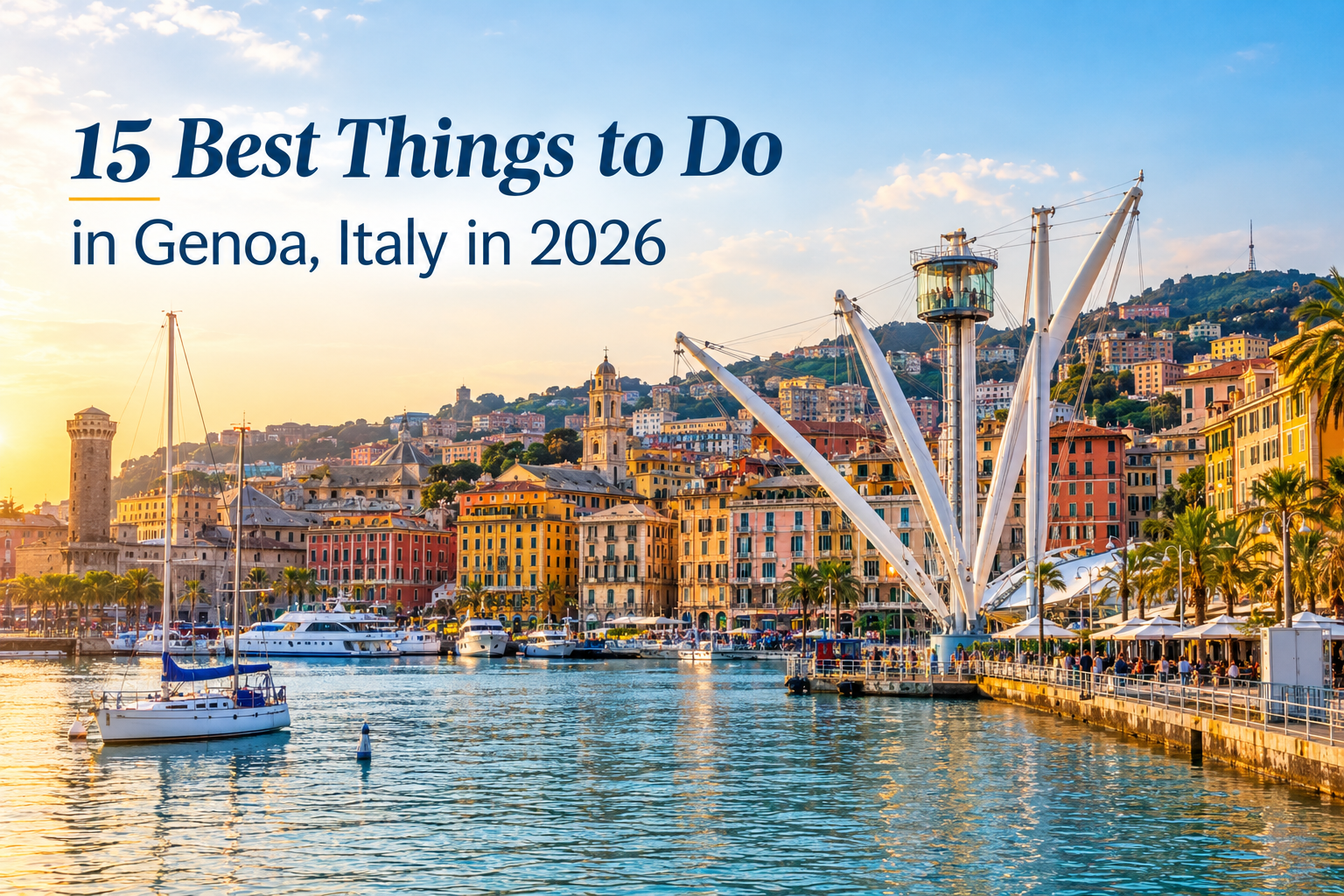
- The Bigo: a rotating panoramic lift shaped like a ship’s crane that lifts you about 40 meters (130 feet) for a 360° view of the port.
- The Biosphere: a glass sphere on the water holding a small tropical forest with plants, birds and butterflies.
Tip: The Aquarium sells combined tickets with the Bigo and Biosphere, which work out cheaper than buying each one separately.
4. Get Lost in the Caruggi (Old Town)
Genoa’s historic center is one of the largest medieval old towns in Europe, a maze of narrow lanes called caruggi that open suddenly onto small squares and baroque churches. Getting turned around is part of the fun. Look up as you walk: many buildings have painted façades with fake columns and windows that look 3D from the street. Keep your bag close in the busier lanes near the port.
5. Visit the Cathedral of San Lorenzo
Genoa’s black-and-white striped cathedral mixes Romanesque and Gothic styles. Inside, look for the 381 mm shell that the British battleship HMS Malaya fired into the cathedral on February 9, 1941. It never exploded and is still on display. The treasury museum holds the Sacro Catino, a green glass dish that legend once linked to the Holy Grail.
6. See Piazza De Ferrari and Palazzo Ducale
Piazza De Ferrari is Genoa’s grand central square, built around a large bronze fountain and ringed by the Teatro Carlo Felice opera house and the old stock exchange. Right beside it stands Palazzo Ducale, the former seat of Genoa’s doges, which now hosts major art exhibitions. You can climb its Grimaldina tower to see the old prison cells, where the violinist Niccolò Paganini was once held. The square looks best after dark, when the fountain and buildings light up.
7. Step Inside Palazzo Reale and Its Hall of Mirrors
On Via Balbi, Palazzo Reale was built by the Balbi family in the 1640s and later enlarged by the Durazzo family, before the Savoy royal family bought it in 1824. Its gilded Hall of Mirrors and hanging garden, with views over the port, are some of the most impressive interiors in the city, and it’s usually far quieter than the Via Garibaldi museums.
8. See Porta Soprana and Columbus’s House
Porta Soprana is a twin-towered medieval city gate from the 1100s. Right beside it is a small stone house where, by tradition, Christopher Columbus spent part of his childhood. It’s a quick stop, but a fitting one in Columbus’s hometown.
9. Ride the Lift to Spianata Castelletto
For one of the best free views in Genoa, take the public Castelletto lift from Piazza Portello up to the Spianata Castelletto terrace. It takes seconds and runs on a standard AMT public transport ticket. Go around sunset for golden light over the port, the Lanterna and the old-town rooftops.
10. Explore the Galata Museo del Mare
Billed as the largest maritime museum in the Mediterranean, the Galata covers Genoa’s centuries as a seafaring power, with a full-size reconstructed galley and a moving exhibit on the Italians who emigrated to the Americas from this port. Your ticket (about €17–18 for adults) also gets you aboard the Nazario Sauro, a real submarine moored outside.
11. Climb the Lanterna, Genoa’s Lighthouse
The Lanterna is the symbol of Genoa. Rebuilt in 1543 on a site used since the 1100s, it stands 77 meters tall, making it the tallest lighthouse in the Mediterranean. Climb 172 steps to the first terrace and visit the small multimedia museum at its base. While nearby tunnel works continue, access is by a shuttle from Piazzale San Benigno, and tickets are reduced to €6.
12. Tour the Eccentric Castello d’Albertis
This neo-Gothic castle above the old port was built between 1886 and 1892 for sea captain Enrico Alberto d’Albertis. Today it holds the Museum of World Cultures, filled with objects he collected on his voyages. Reach it with the Montegalletto lift near Piazza Principe station. It’s much less crowded than the main sights and worth an hour.
13. Take the Righi Funicular and Walk the Forts
The Righi funicular has climbed from Largo Zecca into the hills since 1897. From the top, trails link a ring of old forts with sweeping views back over the city and coast. Wear proper shoes; the paths are steep in places.
14. Visit the Monumental Cemetery of Staglieno
Staglieno is one of the largest cemeteries in Europe and feels more like an open-air sculpture museum, with dramatic 19th-century tombs stepping up the hillside. Mark Twain wrote in The Innocents Abroad that he would remember it after forgetting Genoa’s palaces. It’s free to enter and a short bus ride north of the center.
15. Spend an Evening in Boccadasse and Walk Corso Italia
Boccadasse is a tiny former fishing village, still inside the city, with pastel houses around a pebble beach and a couple of good gelato shops. Walk there along Corso Italia, Genoa’s long seafront promenade, for sea views the whole way. It’s the classic sunset spot for locals.
16. Have an Aperitivo in Piazza delle Erbe
This small old-town square fills up every evening with locals ordering an aperitivo: a drink that comes with snacks such as focaccia and olives. It’s the best place to see Genoa’s evening rhythm up close.
17. Eat Pesto and Focaccia Where They Were Invented
Pesto alla Genovese and Ligurian focaccia both come from here, and the difference from what’s served elsewhere is easy to taste. Find a sciamadda, a traditional Genoese wood-oven shop, for focaccia and farinata straight from the oven, and order trofie al pesto at a trattoria in the old town. A guided food tour is an easy way to try everything in one morning.
Read more: Best Places to Travel in Italy: Complete Italy Travel Guide and Hidden Gems in Florence if you’re combining Genoa with Tuscany.
Genoa Itinerary: What to Do in 1, 2 or 3 Days
One Day in Genoa
- Morning: Via Garibaldi and one or two of the Strada Nuova museums, then the Castelletto lift for the view.
- Lunch: Focaccia and farinata from a sciamadda in the caruggi.
- Afternoon: San Lorenzo Cathedral, Piazza De Ferrari, then down to Porto Antico for the Aquarium or the Bigo.
- Evening: Aperitivo in Piazza delle Erbe and trofie al pesto for dinner.
Two Days in Genoa
- Day 1: The one-day plan above.
- Day 2: Galata Museo del Mare in the morning, Palazzo Reale after lunch, then the bus to Boccadasse and a sunset walk along Corso Italia.
Three Days in Genoa
- Day 3: Choose between the city’s quieter side (Staglieno, Castello d’Albertis and the Righi funicular) or a day trip to Camogli, Portofino or Cinque Terre.
Is Genoa Worth Visiting?
Yes. Genoa is one of Italy’s most underrated cities. It has UNESCO-listed palaces, the country’s largest aquarium, a real lived-in old town, and some of the best food in Italy, with far fewer tourists than Rome, Florence or Venice. It works as a 2–3 day stop on its own and as a base for day trips along the Italian Riviera.
Is Genoa Safe for Tourists?
Yes, Genoa is generally safe. Like any large port city, watch your bags in crowded spots, on buses and in the busier old-town lanes near the port. The old town is lively in the evening, when locals fill its squares for aperitivo.
Where Is Genoa, Italy?
Genoa sits on the Ligurian coast in northwest Italy, between the sea and the Apennine Mountains, roughly halfway between the French border and Tuscany. By train it’s about 1.5–2 hours from Milan, about 2–2.5 hours from Ventimiglia on the French border, and 1–1.5 hours from Cinque Terre.
Genoa is not Geneva. Geneva is in Switzerland, on Lake Geneva; Genoa (Genova) is in Italy, on the Ligurian Sea.
Best Time to Visit Genoa
| Season | Weather | Good to know |
|---|---|---|
| Spring (Apr–Jun) | 15–24°C / 60–75°F, mild | Great for walking; spring Rolli Days edition |
| Summer (Jul–Aug) | Up to about 29°C / 85°F | Driest but busiest and priciest; beaches open |
| Fall (Sep–Oct) | 18–24°C / 65–75°F, mild | Fewer crowds, sea still warm; October Rolli Days |
| Winter (Nov–Mar) | Cool, rainiest months | Lowest prices; museums and the Aquarium stay open |
Getting To and Around Genoa
From the airport: The Volabus runs from Genoa Airport to both main train stations in about 30 minutes.
By cruise ship: The cruise terminal sits by the Old Port, within walking distance of Via Garibaldi, Piazza De Ferrari and the Aquarium.
In the city: Most sights are walkable. AMT tickets cover buses, the metro, the funiculars and the public lifts, and a 24-hour ticket is the easiest option if you’ll ride several times. Check current fares on the AMT website before you go.
| Attraction | Walk / public transport | Taxi alternative |
|---|---|---|
| Via Garibaldi, caruggi, cathedral, De Ferrari, Porta Soprana | Walk; all inside the old town | Not needed |
| Porto Antico (Aquarium, Bigo, Biosphere, Galata) | 5–10 minute walk from the old town | Not needed |
| Spianata Castelletto | Public lift from Piazza Portello | Not needed |
| Righi forts | Righi funicular from Largo Zecca | Not needed |
| Castello d’Albertis | Montegalletto lift near Piazza Principe station | About €10, 5 minutes |
| Lanterna | Shuttle from Piazzale San Benigno (during tunnel works) | Taxi to Piazzale San Benigno |
| Staglieno Cemetery | Bus 34 from Piazza Principe | About €13–17, 7 minutes |
| Boccadasse | Bus 31 from Brignole station, or bus 42 along Corso Italia | About €10–14, 5–10 minutes |
| Corso Italia | Bus 31 or 42, or walk east from the Foce district | About €8–12 |
Taxi fares are estimates from the city center and vary with traffic and time of day. If you’re coming back from dinner in Boccadasse after dark, take a taxi: evening buses run less often, and the ride to the center is short.
Taxis: Uber doesn’t operate in Genoa. Use the itTaxi app or call Radio Taxi Genova at 010 5966.
From elsewhere in Italy: The train from Milan takes about 1.5–2 hours, the easiest way to link the two cities without a car.
Prefer a guide? A two-hour walking tour of the old town and Rolli palaces points out details you’d otherwise walk right past.
What to Eat in Genoa: Local Dishes to Try
- Pesto alla Genovese: basil, pine nuts, garlic, Parmigiano and Pecorino, usually with trofie or trenette pasta.
- Focaccia Genovese: soft, salty, olive-oil-soaked flatbread. Locals dunk it in cappuccino at breakfast.
- Farinata: a thin, crispy chickpea pancake from the wood oven.
- Pansoti with walnut sauce: herb-filled pasta in a creamy walnut sauce.
- Focaccia di Recco: paper-thin focaccia filled with melted cheese, from the nearby town of Recco.
- Torta Pasqualina: a savory pie of greens, ricotta and egg, sold year-round.
To find a good restaurant, skip places near the port with photo menus in five languages and look for a trattoria in the old town, especially around Piazza delle Erbe and Via San Bernardo.
Where to Stay in Genoa: Best Areas
- Old town and Piazza De Ferrari: best for first-timers who want to walk everywhere. Hotel Bristol Palace, a 5-star on Via XX Settembre, is a few minutes from the square and the cathedral.
- Porto Antico (waterfront): best for families, next to the Aquarium. NH Collection Genova Marina sits right on the harbor.
- Piazza Principe: handy for trains, the cruise terminal and the Montegalletto lift. Hotel Continental Genova is beside the station and has a spa.
- Brignole and Carignano: more residential, with easy trains east toward Portofino and Cinque Terre.
Want flights, hotels and tours handled in one booking? GoGo Trips builds custom Italy itineraries that include Genoa and the Italian Riviera.
Genoa for Couples, Families and Solo Travelers
Couples: Ride the Castelletto lift at sunset, walk Corso Italia, and have dinner in Boccadasse. Take a taxi back; it’s short and easier than waiting for an evening bus.
Families: Base yourselves near Porto Antico. The Aquarium, Bigo, Biosphere and the Galata submarine fill a full day, and Boccadasse’s beach and gelato make an easy afternoon.
Solo travelers: The old town is made for wandering. Join a walking or food tour on your first morning, then finish the day at an aperitivo bar in Piazza delle Erbe.
Beaches in Genoa
- Boccadasse: small, pebbly and the most photographed beach in the city.
- Vernazzola: a quiet fishing cove a short walk past Boccadasse.
- Sturla: a longer beach with cafes and restaurants on the water.
- Nervi: the nearly 2-kilometer Anita Garibaldi promenade and seaside parks, one of the prettiest walks on this coast.
Best Day Trips from Genoa
- Cinque Terre: 1–1.5 hours by train. Go early in summer to beat the crowds.
- Portofino: train to Santa Margherita Ligure, then a short bus or ferry. Summer ferries also run directly from Genoa.
- Camogli and San Fruttuoso: about 45 minutes by train to Camogli, then a ferry or coastal trail to the San Fruttuoso abbey, which has no road access.
Skip the rental car for these trips. Parking on the Riviera is scarce and expensive, and the train is faster door to door.
Good to Know Before You Go
- English is less widely spoken than in Rome or Florence outside hotels and major sights. A few Italian phrases go a long way.
- Small focaccerie and market stalls may be cash-only. Use a bank ATM (bancomat) rather than airport exchange desks.
- Tipping isn’t expected; rounding up is plenty.
- Genoa’s nickname is La Superba (“the proud one”), earned during its centuries as a maritime republic. It was also a European Capital of Culture in 2004.
- Football fans: Genoa C.F.C., founded in 1893, is Italy’s oldest active football club.
- Packing for a long trip? See our packing checklist for long journeys.
Plan Your Genoa Trip
Genoa is one of the best-value stops in Italy: a real, working city with world-class sights and none of the crowds of Rome or Venice. Pair two or three days here with day trips to Cinque Terre and Portofino for one of the best short trips on the Italian Riviera.
Plan your Genoa and Italian Riviera trip with GoGo Trips →
Frequently Asked Questions About Genoa
What is Genoa, Italy best known for?
Genoa is known for its UNESCO-listed Palazzi dei Rolli, its historic port, Italy’s largest aquarium, the Lanterna lighthouse, and as the birthplace of pesto Genovese, focaccia and Christopher Columbus.
How many days do you need in Genoa?
Two to three days covers the main sights. Add one day for each Riviera day trip, such as Cinque Terre or Portofino.
What is there to do in Genoa at night?
Have an aperitivo in Piazza delle Erbe, see Piazza De Ferrari lit up, catch an opera at Teatro Carlo Felice, or watch the sunset from Spianata Castelletto or Boccadasse.
What are some hidden gems in Genoa?
Castello d’Albertis, Palazzo Reale’s Hall of Mirrors, Staglieno Cemetery, the Righi forts and the fishing cove of Vernazzola see far fewer visitors than the Aquarium or Via Garibaldi.
Is Genoa expensive to visit?
Genoa is generally cheaper than Florence, Venice or the Cinque Terre towns for hotels and food. Many highlights, including the caruggi, the cathedral, Staglieno and Boccadasse, are free.
Can you visit Cinque Terre and Portofino from Genoa?
Yes. Both are reachable by train in about 1 to 1.5 hours, so Genoa makes a convenient base without changing hotels.
Is Genoa safe for tourists?
Yes. Genoa is generally safe. Use normal city precautions with bags in crowded areas, on buses and in the busier old-town lanes near the port.
What is the best time to visit Genoa?
April to June and September to October bring mild weather and fewer crowds. July and August are hot and busy; winter is cheaper but rainier.
Does Genoa have beaches?
Yes. Boccadasse is the best known, and Vernazzola, Sturla and Nervi are also within the city and easy to reach by bus.
What currency is used in Genoa?
The euro (€). Cards work in most hotels and restaurants, but carry some cash for small focaccerie and market stalls.
Is Genoa the same as Geneva?
No. Genoa (Genova) is in Italy on the Ligurian Sea; Geneva is in Switzerland on Lake Geneva.
Does Uber work in Genoa?
No. Use the itTaxi app or call Radio Taxi Genova at 010 5966.
Sources for prices and opening times: Aquarium of Genoa, Musei di Genova, Visit Genoa and AMT Genova official websites, checked October 2026.
All Categories
Recent Posts

9-Day Vietnam Itinerary 2026: Hanoi, Ha Long Bay, Da Nang and Ho Chi Minh City

Las Vegas Trip Guide 2026: Top Attractions, Vacation Packages and Real Costs

Top Tourist Attractions in Paris: 15 Best Places to Visit in 2026